[July 7, 2026]
The Biggest Viral Moments and How They Happen
A field guide to viral moments: the mechanics that ignite them, the lifecycle they follow, and the criteria WhoTalking uses to log the ones that last.
WhoTalking tracks the people, stories, and viral moments commanding global attention — reading the social conversation across the US, Japan, Brazil, and Europe, and explaining why each name is rising while others fade.
| # | Subject | Region | Momentum | Trend | Attention |
|---|---|---|---|---|---|
| 01 |
REEVES.K
Keanu Reeves
|
US | +24.2 | 94.2 | |
| 02 |
KIMURA.T
Takuya Kimura
|
JP | +18.1 | 91.7 | |
| 03 |
ANITTA
Anitta
|
BR | +12.0 | 88.4 | |
| 04 |
MBAPPE.K
Kylian Mbappé
|
FR | +9.4 | 86.1 | |
| 05 |
OHTANI.S
Shohei Ohtani
|
JP | 0.0 | 85.3 | |
| 06 |
ZENDAYA
Zendaya
|
US | +7.0 | 83.9 | |
| 07 |
YOASOBI
YOASOBI
|
JP | +5.6 | 80.2 | |
| 08 |
SILVA.T
Thiago Silva
|
BR | -4.2 | 77.8 |
A field guide to viral moments: the mechanics that ignite them, the lifecycle they follow, and the criteria WhoTalking uses to log the ones that last.
A category-by-category ledger of the conversations that dominate global feeds and the forces that push each one to the top.
Emmy records, two of the era's biggest franchises and a deliberate fashion signal keep Zendaya among the most searched performers of her generation.
Anitta turned Rio funk into a trilingual global project and made herself Brazil's most reliable entry on worldwide attention boards.
From SMAP to record-setting dramas and a durable solo career, Takuya Kimura remains the fixed point of Japanese celebrity attention.
Four decades of franchise work and an unmatched reserve of internet goodwill keep Keanu Reeves permanently on the global attention board.
From SMAP to record-setting dramas and a durable solo career, Takuya Kimura remains the fixed point of Japanese celebrity attention.
WhoTalking reads the global conversation as a ledger of attention. By distilling social volume into human narratives, the index surfaces the figures shaping the cultural trajectory — precision over clutter, context over noise.
Anyone asking who is trending globally right now is really asking three separate questions: who is spiking on search engines, who is dominating social feeds, and who is holding attention long enough to still matter tomorrow. The three answers rarely match. WhoTalking exists to reconcile them — a single editorial index that tracks the people the world is talking about, across platforms and across borders.
Most trend tools answer only one slice of the question. Google Trends shows search acceleration. Hashtag trackers list X topics that cycle out within hours. News aggregators republish whatever is already loud. None of them explain why a name is rising, where the attention originates, or how long it is likely to last.
That explanatory layer is the gap this index fills. WhoTalking reads raw attention signals from the United States, Japan, Brazil, and Europe, scores every name on a 0–100 attention scale, and publishes the reasoning in plain language. What follows is the full method: how attention works now, how platforms measure trending, how the four core markets differ, and how the editorial desk converts noisy data into a readable ledger.
Global attention no longer flows through a handful of broadcasters. It moves through recommendation algorithms, organized fan communities, and search behavior — three systems that interact constantly but obey different rules. A television moment becomes a clip, the clip becomes a sound, the sound becomes a search query, and by the end of that chain the original context is optional.
Two properties define the current era. First, attention is fragmented: no single platform sees the whole picture, and a person can dominate short-video feeds while remaining invisible on X. Second, attention synchronizes in bursts: when a story is large enough, every platform lights up within the same hour — and that crossover is the most reliable signal a story is real.
The basic unit of global attention is almost always a person. Policies, products, and disasters trend, but names travel faster than concepts because names carry faces, rivalries, and narratives. That is why WhoTalking organizes coverage around profiles of the people driving global attention rather than around abstract keywords — the person is the index entry; everything else is context.
Geography still matters far more than the word “global” implies. A worldwide trending list is not a list of things the entire world cares about; it is a list of things several large national audiences happen to care about at the same moment.
“Trending” is not one metric. Every platform defines it differently, weights it differently, and refreshes it on a different clock. Most confusion about who is trending globally comes from treating these incompatible measurements as if they were one number.
Google Trends measures relative search interest, not raw volume, and normalizes every result onto a 0–100 scale against the query’s own baseline. A score of 100 marks peak popularity for that term in the selected window, not an absolute count. The Trending Now feed surfaces queries whose demand accelerated sharply, which is why an obscure name can outrank a permanent celebrity: the celebrity’s searches are enormous but flat; the newcomer’s grew fifty-fold overnight.
Search is the intent layer of attention. People type a name because they actively want to know who someone is or what they did. That makes search spikes slower than social spikes but considerably harder to fake.
Trending topics on X reward sharp spikes over sustained volume. A phrase mentioned heavily all day can be outranked by one that exploded in the last hour, because the algorithm privileges acceleration and novelty. Trends are also computed per market, so the worldwide list is effectively a merge of national conversations — the reason one glance can show an American athlete, a Brazilian TV contestant, and a Japanese voice actor stacked together.
X remains the fastest public gauge of live reaction — and the noisiest, since coordinated fan pushes can lift a tag without any underlying news event.
Short-video platforms rarely trend a person directly. They trend a sound, a template, a gesture — and people ride the format into visibility. Distribution is decided by recommendation engines rather than follower graphs, so an unknown can outperform a superstar on any given day. The practical consequence: short-video fame often arrives before search fame — a face circulates for days before curiosity sends viewers to a search bar to attach a name to it.
YouTube’s trending tab weighs view velocity, upload recency, and source variety — a strong mid-speed indicator for music and entertainment. Reddit surfaces stories through votes, a proxy for engaged interest rather than passive exposure. Wikipedia pageviews are the quiet tell of the whole system: when a name spikes in search and encyclopedia traffic simultaneously, curiosity is genuine and broad. A social spike without any reference-lookup echo is usually fandom machinery, not public interest.
WhoTalking concentrates on four markets — the United States, Japan, Brazil, and France as the anchor of continental Europe — because together they generate an outsized share of worldwide trends and behave in four distinct ways. Reading them separately is the only honest way to read them.
The American attention market is the world’s largest exporter of trends. Its entertainment industry, sports leagues, and political theater are followed far beyond its borders, so a purely domestic story — an awards-show moment, a draft pick, a courtroom development — routinely becomes a global one within hours. English amplifies everything: an American trend needs no translation to travel.
It is also the most commercially saturated market: publicity cycles, album rollouts, and film promotion are engineered to look like spontaneous conversation, and separating the two is a daily editorial task.
Japan runs one of the most active posting cultures on X, and its attention follows the broadcast calendar with remarkable discipline. Seasonal anime premieres, idol group announcements, voice-actor news, and televised specials produce synchronized national surges — Japanese audiences have repeatedly set platform activity records during anime rebroadcasts and New Year greetings. Because the conversation happens in Japanese, the names are massive at home yet opaque to outsiders — which is why unfamiliar scripts keep appearing on worldwide lists. The dedicated Japan entertainment desk exists to translate that cycle: who the name belongs to, which franchise or agency moved, and why the spike happened on schedule.
Brazil is the loudest collective actor in global social media. Its fan communities treat trending as a team sport — organized, fast, and persistent — and its television culture produces conversation records that few countries can match; Big Brother Brasil has ranked among the most-tweeted programs on the planet. Football, telenovelas, music, and reality TV give Brazilian audiences a constant supply of shared events, and Portuguese-language tags routinely conquer the worldwide list on sheer coordination. When a Brazilian name goes global, volume is rarely the question; the editorial question is whether anyone outside the fandom is engaging.
Europe is not one attention market but a lattice of language-bound ones. A scandal that consumes France may not register in Germany; a Spanish television feud stops at the Pyrenees. Only a few forces reliably cross the internal borders: club football and its transfer sagas, the Eurovision Song Contest, continental politics, and the occasional royal story. France anchors the index’s European coverage because its media system is large, centralized, and quick to turn cultural debates into national ones — a reliable barometer for when European attention does consolidate.
Across all four markets, the people who trend fall into six recurring categories. The proportions shift by country and by season, but the taxonomy itself is stable — stable enough that every story is filed into topic clusters comparable across borders and years.
The categories also interact. A musician dating an athlete merges two fandoms into one storyline; a founder feuding with a politician cross-pollinates normally separate audiences. Cross-category stories consistently reach the highest attention scores: they recruit several publics at once.
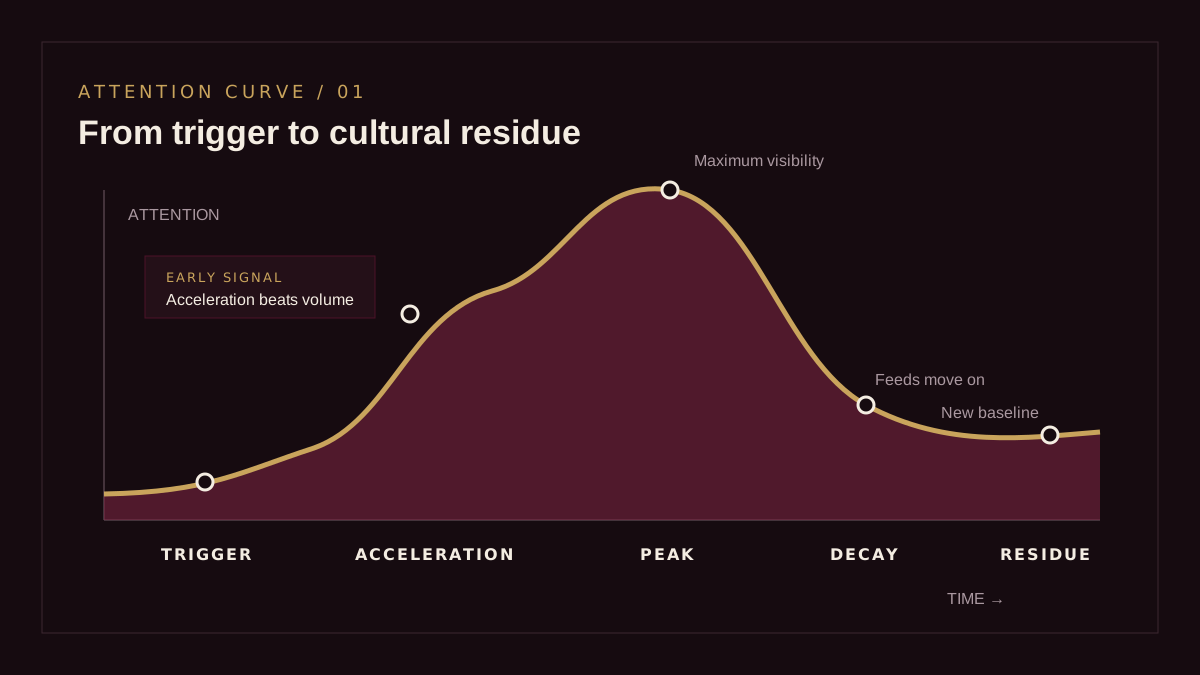
Attention decays on a schedule that is more regular than most people expect. Names differ, markets differ, but the shape of the curve barely changes: ignition, acceleration, peak, decay, residue. What varies is the amplitude and the length of the tail.
The durations below are editorial heuristics — typical ranges the desk works with, not laws. Individual stories can compress or stretch every stage.
| Stage | Typical window | What it looks like | Dominant signal |
|---|---|---|---|
| Ignition | 0–2 hours | A clip, post, or headline escapes its original audience | Reposts and quote-posts accelerate |
| Acceleration | 2–12 hours | Fan accounts, aggregators, and press pick the story up | Hashtag velocity; search queries begin |
| Peak | 12–48 hours | The name tops platform lists in several countries at once | Cross-platform and cross-border crossover |
| Decay | 2–7 days | Commentary replaces news; feeds rotate to fresher stories | Velocity falls while totals stay high |
| Residue | 2 weeks–6 months | Anniversaries, references, and searches resurface the name | Search and encyclopedia baselines settle higher |
The peak is the only stage most trend trackers record, and it is the least informative one. By the time a name tops a worldwide list, the interesting questions — who ignited it, which market carried it, whether the curiosity is real — were answered hours earlier. The viral moments ledger documents these curves case by case: the record of how attention moved is worth more than a screenshot of its peak.
Residue is the stage everyone underestimates. A person who trends hard once is permanently easier to trend again: their search baseline settles higher, their name carries recognition, and the next spike starts from a higher floor. Attention compounds.
The index runs on a simple discipline: collect broadly, weigh conservatively, explain everything. No single platform is trusted on its own, and no score is published without a human having asked the obvious question — what actually happened?
Collection covers the signal families described above — search acceleration, X trend velocity, short-video circulation, YouTube and Reddit traction, reference lookups — tracked per market. Weighing rewards two things above all. Cross-platform crossover: a name spiking on three independent systems is a story; a name spiking on one is usually machinery. Cross-border crossover: attention that jumps a language barrier is rarer and more meaningful than attention that saturates a single country.
Every tracked name receives an attention score from 0 to 100. The scale is relative and editorial, in the same spirit as normalized search indices: it expresses how completely a person occupies global conversation, not a raw count of posts or searches.
The editorial layer is what separates an index from a scraper. Scores are adjusted downward when volume shows the fingerprints of coordination — identical phrasing, giveaway mechanics, vote-brigading — and upward when independent signals confirm organic curiosity. Each day’s output is published as a ranked ledger on the trending board, each entry paired with the reasoning: what moved, where it moved, and what the score reflects.
The method has limits, and stating them is part of the method. Private platforms expose partial data; closed messaging apps expose none. Scores describe visible public attention — a disciplined reading of the observable, nothing more.
It means the volume of activity around their name is growing unusually fast against its own baseline. Trending measures acceleration, not size: a moderately known person whose mentions multiply overnight will out-trend a megastar whose enormous mention count stays flat.
The top spot rotates with news cycles, but annual search rankings are consistently dominated by US presidents and presidential candidates, championship athletes, and headline entertainers. Donald Trump has topped global people-search rankings in multiple years; election periods reliably reshuffle the whole leaderboard.
Platform-native tools each show one slice: Google Trends for search, the X trends panel for hashtags, the trending tabs on YouTube and TikTok for video. An editorial index consolidates those slices and explains why each name is rising — the daily function of the trending board here.
Because trends are computed per market and reflect national conversations first. Language, time zones, broadcast schedules, and local fixtures shape what each country talks about, and the worldwide list is a merge of those national layers rather than a separate global measurement.
Most social trends peak within 12 to 48 hours and decay within a week. Search interest fades more slowly than hashtags, and a serious story can leave an elevated baseline for months after the feeds move on.
Trending is a ranking outcome: a platform’s algorithm lists a topic among the most accelerating at that moment. Viral describes a propagation pattern: content spreading person-to-person through shares. Viral content often causes trending, but a topic can trend through coordinated posting without any single viral artifact behind it.
Japan and Brazil operate two of the most active posting cultures on X, so their domestic conversations regularly outweigh everyone else’s at the global level. A seiyuu announcement in Tokyo or a reality-show elimination in São Paulo can generate more synchronized volume than a mid-sized English-language story.
Volume can be manufactured — fan-coordinated tag pushes, giveaway mechanics, and bot amplification all inflate hashtags. What is hard to fake is the confirmation layer: independent search demand, reference lookups, and cross-platform echo. The index therefore scores coordination-heavy spikes lower than organically confirmed ones.
Usually because of calendar mechanics: birthdays, debut anniversaries, and fandom rituals produce scheduled tag pushes with no news behind them. Rebroadcasts, resurfaced clips, and namesake confusion during breaking news account for most of the rest.
It is the 0–100 editorial rating attached to every name tracked here, expressing how completely a person occupies global conversation at a given moment. The score weighs acceleration, cross-platform crossover, cross-border reach, and the authenticity of the underlying volume.
Raw counts are incomparable across platforms and gameable within them; one platform’s million is another’s rounding error. A normalized scale — the same convention search indices use — makes a K-pop comeback, a political resignation, and a football transfer legible on one axis.
Search trend data, X trend velocity, short-video circulation, YouTube trending, Reddit traction, and encyclopedia pageviews, read per market. No single source is decisive; agreement between independent sources is what moves a score.
The ledger runs a daily editorial cycle, with entries revised as stories develop. The cadence is deliberate: hourly lists capture noise; a daily reading captures which names held their position once the churn settled.
Rarely on its own. Most names exit the ledger within a week and never return. Lasting relevance shows up as a pattern — repeated spikes, a rising search baseline, coverage that survives the original story — which is what longitudinal profile tracking reveals.
A death compresses an entire career into a single day of remembrance and reaches every audience at once — fans, media, and casual observers who simply recognize the name. Passings routinely produce the largest single-day search spikes of any story type; year-end search reports track them as their own category.
No — they measure different behaviors on different clocks. Google Trends tracks what people actively search for, normalized 0–100 against each query’s own history; X trends rank what people are posting about right now, weighted toward the sharpest short-term spikes. A name can lead one list while absent from the other — a gap that is itself diagnostic.