Trending Topics Worldwide: What Global Feeds Talk About
A category-by-category ledger of the conversations that dominate global feeds and the forces that push each one to the top.
Trending topics are the visible tip of a much larger structure: beneath every ranked term sits a category with its own calendar, its own fan economics and its own national biases. Entertainment does not trend the way politics trends. Sports do not decay the way memes decay.
WhoTalking sorts the global conversation into six recurring ledgers — entertainment, politics and news, sports, music, internet culture, and business — because each behaves differently enough to demand its own reading rules. This page describes what drives each category, how fast it moves, and where markets diverge from the global pattern.
For the mechanics of the lists themselves — how platforms compute rank, and why momentum beats raw volume — see the Trending desk. The live cross-market board runs on the front page.
What pushes any topic to the top
Across every category, five forces do most of the lifting:
- The calendar. Premieres, match days, elections, earnings dates and award shows are scheduled attention. The largest share of predictable trends is booked months in advance.
- The rupture. Breaking news, upsets, outages and scandals — unscheduled events that spike hardest and are hardest to sustain.
- The drop. Releases: albums, trailers, seasons, products. Engineered spikes with marketing budgets behind them.
- The fandom. Coordinated communities that can move a name onto the boards with no external trigger at all.
- The format. A meme or challenge that carries a subject further than the subject could travel alone.
Each category below mixes these forces in a different ratio, and the ratio is what a trained reader learns to recognize.
Entertainment: the person-driven ledger
Film and television trends are overwhelmingly attached to names. Casting announcements, premiere carpets, streaming-drop weekends and awards season dominate the category, and the durable subjects are performers rather than titles — which is why the People index functions as entertainment’s long-term memory. A franchise film trends for a weekend; its lead trends, at lower intensity, for a decade.
Market divergence here is strong. Hollywood’s calendar sets the global rhythm, but the biggest entertainment conversations in Japan revolve around domestic dramas, anime seasons and idol agencies — a parallel system large enough that the index runs a dedicated Japan Entertainment desk for it. India’s film industries, Korea’s drama cycles and Latin America’s streaming markets behave the same way: locally enormous, unevenly visible on English-language boards.
Politics and news: the spike ledger
Political topics produce the sharpest spikes and the most contested framing. Elections, legislation, court decisions and geopolitical events arrive as ruptures, peak within hours, and split immediately along national and ideological lines. The same event often trends under different terms in different communities, which makes raw term-matching unreliable in this category.
Politics is also the most geographically confined ledger. Outside of wars, summits and a handful of heads of state, political topics rarely cross language borders at full strength: a debate that owns one country’s feeds can be invisible two borders away. The reliable exceptions are American politics, which exports globally, and sudden hard news, which crosses everywhere at once.
Sports: the metronome
Sport is the most predictable attention machine the index tracks. Fixtures are public, fandoms are permanent, and every match day produces its scheduled wave of team names, player names and incident terms. Football carries the largest cross-border load; cricket concentrates enormous volume in South Asia; American football and basketball dominate United States boards; baseball splits its weight between the United States and Japan.
Two sports patterns matter for reading. Transfer windows and drafts generate speculation trends with no event behind them — high volume, low information. And tournament knockouts produce the truest global moments the board ever shows: a World Cup final reaches markets that share no language and no platform culture.
Music: the release-cycle ledger
Music runs on a weekly clock: releases cluster on Fridays, charts confirm early the next week, and fandoms fill the space between with coordinated streaming and hashtag drives. K-pop comebacks remain the most organized attention operations on any platform, reliably converting a committed base into global-scale spikes. Latin pop and Afrobeats cross borders through collaboration chains, pairing artists across markets so that each release imports the other’s audience.
The category’s wildcard is the format revival: a song attached to a viral clip format can chart decades after its release, with the trend beginning on short-form video and only later surfacing in search and streaming data. In music more than anywhere else, the trending name and the trending object are different things — the artist trends because a fifteen-second excerpt did.
Internet culture: the fast ledger
Memes, challenges, creator feuds and platform drama form the fastest-moving category on the board. Topics here are usually objects rather than subjects — a clip, a phrase, an image template — and they decay in days at most. The category’s economics run on remixability: whatever is easiest to imitate spreads furthest.
Internet culture is also the least global category that looks the most global. Formats jump borders easily, but the references stay local — the same template carries a different joke in every language. The index files this material in the Viral ledger, separate from topic tracking, because its lifecycle and its evidence trail differ from every other category on this page.
Business and tech: the slow ledger
Business topics trend less often but hold rank longer. Product launches, earnings surprises, layoffs, outages and acquisition news drive the category, with artificial intelligence supplying a persistent baseline conversation in recent years. The audience skews professional, the conversation skews toward X and YouTube, and search interest — people verifying, comparing, deciding — is unusually strong relative to feed noise.
The category’s signature pattern is the outage trend: when a major service fails, the failure trends on every platform that still works, instantly and worldwide. Few events demonstrate the difference between scheduled and rupture attention as cleanly.
How markets diverge
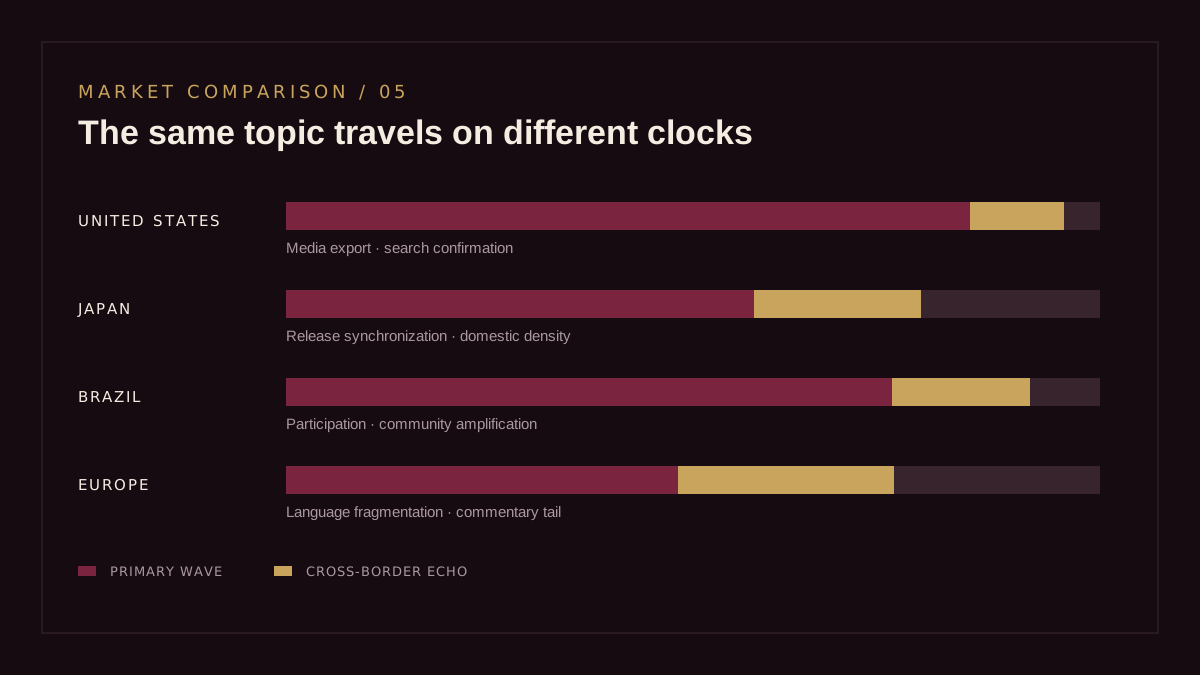
Category weights differ by country, and the differences are stable enough to treat as structure. Sports and politics dominate some markets; entertainment and music dominate others; a handful of markets — Japan among the clearest — run parallel entertainment economies whose biggest names rarely surface on English-language boards at all.
Time zones stagger everything. A story breaking in an American evening hits European mornings and Asian afternoons in sequence, so the “same” trending topic is really three regional waves with different framing. Language borders filter harder than platform borders. And each market’s local calendar — festivals, league seasons, election cycles — occupies board space that global stories must displace before they can be seen.
The practical conclusion: any list of trending topics is a snapshot of one market’s mixture at one hour. The global picture only emerges by reading several markets against each other — which is the design principle behind the entire WhoTalking board.
Frequently asked questions
What is the difference between a trending topic and a trend?
A trending topic is a subject holding rank on a platform’s list — a name, an event, a term. A trend in the broader sense is any pattern of rising attention, including formats and sounds that never appear as a ranked phrase. Every trending topic is a trend; the reverse does not hold.
Which category trends most often?
Sport, by scheduling alone: every match day guarantees a wave. Entertainment follows on the strength of release calendars and awards season. Politics spikes higher but less predictably, and internet culture cycles fastest of all.
Why do political topics disappear from the boards so quickly?
Because platforms favor acceleration over persistence. A political story stops accelerating once the initial event passes, even when the underlying issue continues. The conversation usually fragments into partisan sub-terms, none of which alone re-reaches the threshold.
Are music trends really organized by fans?
Often, yes. Streaming parties, synchronized hashtags and release-day drives are openly coordinated in fan communities, and they are among the most effective legitimate attention operations on any platform. The activity is real engagement — just scheduled engagement.
Why do Japanese entertainment topics rarely appear on global boards?
Language is the main filter: the conversation happens in Japanese, at enormous domestic scale, and English-language boards never see it. Japan’s platform mix and its agency-driven media system add further distance, which is why the index covers the market on its own desk.
How long does a topic typically hold the top position?
It depends on the ledger. Internet-culture objects hold for hours, political ruptures for a day or two, entertainment releases for an opening weekend, sports for the length of the fixture plus its aftermath, and business stories — slower but heavier — can resurface for weeks.
Do trending topics follow news coverage or drive it?
Both directions operate at once. Scheduled events flow from media to feeds; ruptures often flow from feeds to media, with newsrooms picking up what platforms surfaced first. The loop closes when coverage re-feeds the trend it reported on.
Is a trending person different from a trending topic?
Structurally, yes. Person-subjects have long memories: a career, a fandom, a baseline that persists between spikes. Event-subjects reset to zero. That is why person-attention is tracked separately in the People index rather than as disposable topics.
Can one topic dominate every market at the same time?
It happens a few times a year at most — global sporting finals, sudden major news, and the occasional franchise or music event with worldwide release timing. Everything else that claims to be worldwide is, on inspection, a coalition of a few large markets.