The Biggest Viral Moments and How They Happen
A field guide to viral moments: the mechanics that ignite them, the lifecycle they follow, and the criteria WhoTalking uses to log the ones that last.
The spikes that took over the internet — what happened, why it spread, and what it says about how attention moves.
A viral moment is attention at its most concentrated: one clip, one image, or one sentence that briefly outruns every institution built to distribute information. The files on this desk reconstruct those spikes — the trigger, the spread pattern, the peak, and what remained when the feed moved on.
The archive favors moments that reveal how virality actually works: participation challenges that turned charity into a template, award-show incidents that outgrew the broadcast, and market-specific waves from Tokyo, São Paulo, and Paris that never needed English to travel. Each file states what is documented, what is estimated, and what remains folklore.
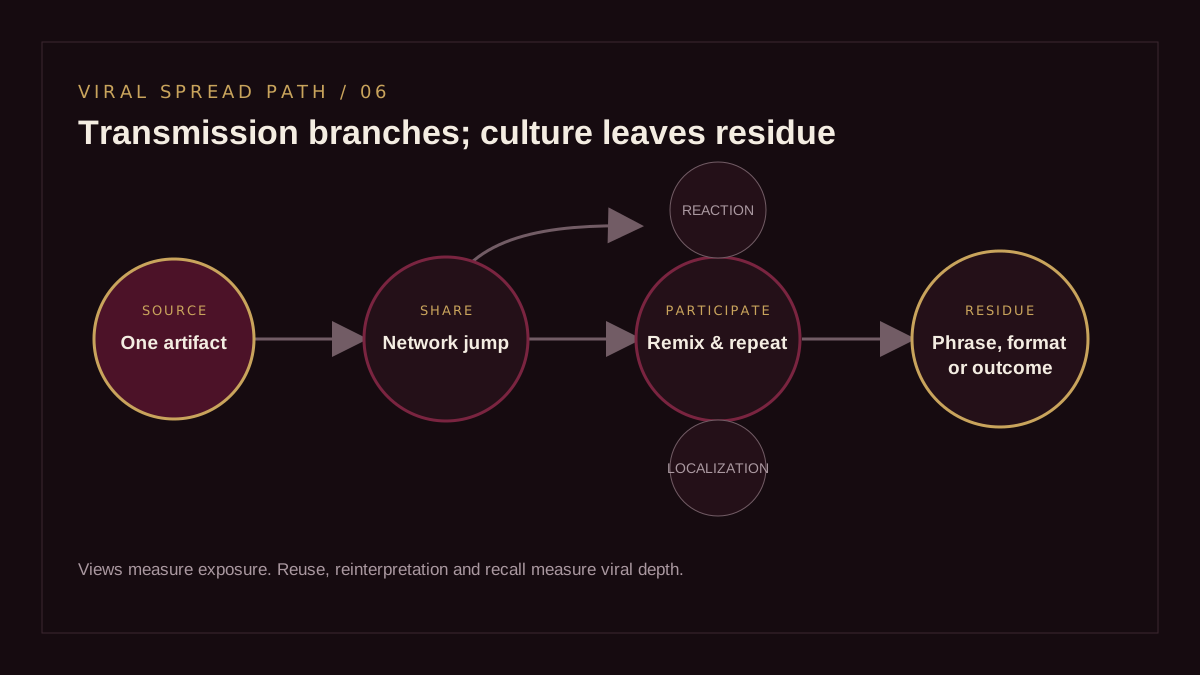
A moment enters the ledger only when people transmit it, not merely view it. Sharing carries the source artifact outward; participation lowers the barrier for new versions; remixing gives later audiences a reason to encounter it again. Those behaviors produce a branching path rather than a single upward line.
The source matters. A television incident begins with a mass audience already assembled, while a creator clip must earn each successive network. A meme can mutate until the original author disappears; a charity challenge survives because the action remains legible even when the first post is forgotten. The files preserve that distinction.
Regional waves are read on their own terms before any claim of worldwide reach. Language, messaging habits, platform availability and time zones determine which artifacts cross borders. Brazil can generate exceptional participation density, Japan can synchronize attention around a scheduled release, and French discourse can keep a moment alive through commentary after visual sharing slows.
Most spikes vanish. The useful question is what remains: a phrase people still use, a format creators can repeat, a higher search baseline for the person at the center, or a real-world outcome. Residue separates a famous screenshot from an event that became part of culture.
Verification begins with the earliest recoverable source. Reposts often remove timestamps, captions and attribution, so the most visible upload is rarely the first one. The desk distinguishes the source artifact from the version that broke into a larger network and records uncertainty when the available evidence cannot establish a clean origin.
Scale does not cancel responsibility. A viral file should explain public behavior without embedding humiliating footage merely for spectacle, repeating unverified accusations or treating the person at the center as raw material. When the artifact itself adds little context, the analysis describes its mechanics and consequences instead of forcing another replay.
Comparing complete lifecycles is the archive’s main advantage. The first hour reveals network structure, the peak shows how broadly a story escaped its source community, the decay exposes whether participation can renew it, and the residue shows what audiences retained. Read together, those stages are a stronger record than view totals captured at one arbitrary moment.
The ledger also separates viral reach from lasting value. Harmful misinformation can spread efficiently; a modest community format can create durable benefit without reaching every platform. Recording mechanics does not celebrate the outcome. It gives readers a vocabulary for asking who gained attention, who carried the cost, and whether the residue was knowledge, participation, commerce, harassment or simply another forgotten clip.
A field guide to viral moments: the mechanics that ignite them, the lifecycle they follow, and the criteria WhoTalking uses to log the ones that last.