The Biggest Viral Moments and How They Happen
A field guide to viral moments: the mechanics that ignite them, the lifecycle they follow, and the criteria WhoTalking uses to log the ones that last.
Viral moments are the base unit of modern internet culture: short, measurable windows in which a single clip, image, phrase, or event captures an outsized share of global attention and briefly reorganizes what millions of people talk about. From the inside, they feel chaotic. From the outside, they follow patterns — repeatable mechanics, a recognizable lifecycle, and platform-specific physics that reward certain content and bury the rest. This page documents those patterns the way WhoTalking documents everything: as entries in a ledger of attention, with the hype stripped out.
The analysis below covers what actually makes a moment travel, the five stages nearly every spike passes through, how virality behaves differently on TikTok, X, YouTube, and Reddit, the recurring categories that produce the biggest spikes, and why Japan, Brazil, and France each bend the standard model in their own way. The moments still climbing right now sit on the trending board; this page explains the machinery behind them.
What Makes a Moment Viral
Virality is not randomness. Three properties appear, in some combination, in nearly every moment large enough to log: emotional charge, low-friction participation, and remixability. A moment can spike with two of the three. The ones that reach the top of the index almost always carry all three.
Emotion: the transmission fuel
People share what makes them feel something sharply — awe, outrage, secondhand embarrassment, joy, disbelief. High-arousal emotions outperform mild ones: content that merely pleases gets liked, while content that astonishes or enrages gets forwarded. This is why an unscripted debate-stage stumble outruns a polished campaign ad, and why a stranger’s act of kindness filmed on a phone can beat a studio production with a thousand times the budget. The feeling is the payload; the clip is only the container.
Participation: the lower the barrier, the wider the spread
The largest viral events are not watched — they are performed. The Ice Bucket Challenge worked because anyone with a bucket and a phone could join in thirty seconds, and its nomination mechanic drafted new participants with every upload. Dance challenges, caption formats, and reaction templates obey the same rule: reduce the cost of joining to near zero and attach a social prompt that makes joining feel expected. Content that can only be admired has a ceiling. Content that can be copied does not.
Publishers and educators are welcome to reuse this graphic with attribution:
Remixability: mutation keeps the moment alive
A moment survives its first week only if other people can build on it. The Harlem Shake was never one video but tens of thousands of them, each a thirty-second variation on a fixed template; at its February 2013 peak, thousands of new versions were being uploaded to YouTube every day. Remix converts an audience into a workforce. It also future-proofs the moment: by the time the original clip goes stale, the derivatives are already carrying the idea somewhere new.
The Anatomy of a Viral Spike
Individual moments differ wildly in content and scale, but the shape of the curve barely changes. WhoTalking maps every logged moment against five stages. The durations below are typical observed ranges, not laws — a sports moment can compress the whole cycle into a weekend, while a slow-burn meme format can stretch it across months.
| Stage | Typical duration | Platform behavior |
|---|---|---|
| Spark | 0–6 hours | A single upload circulates inside one community — a subreddit, a group chat, a fandom corner of X. Raw numbers are small but abnormally intense: high share-to-view ratio, fast reply chains. |
| Spread | 6–48 hours | The moment escapes its origin platform. Screenshots migrate from Reddit to X; clips jump from TikTok to Instagram and YouTube Shorts. Aggregator accounts pick it up, and search volume for the key phrase appears. |
| Peak | Days 2–4 | Maximum reach. The moment trends on several platforms at once, mainstream outlets publish explainers, and people who avoid social media hear about it anyway. Parody accounts and brands begin to join. |
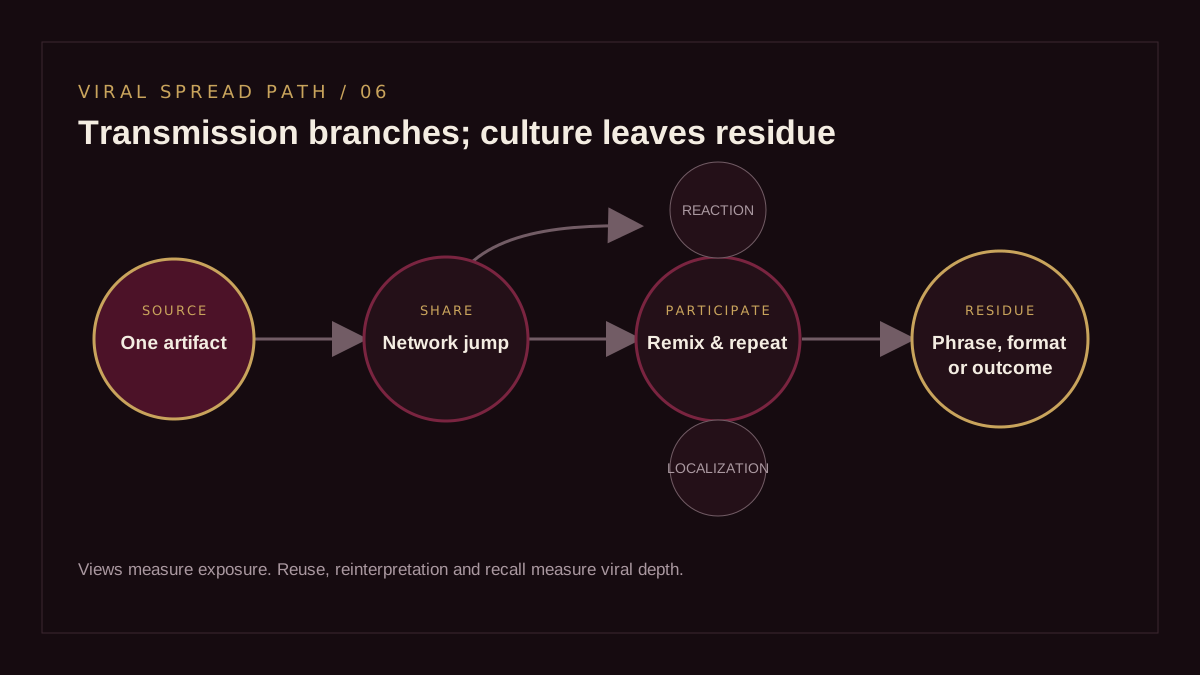
| Remix | Days 3–14 | Derivatives outnumber the original: templates, duets, stitches, reaction formats, localized versions in other languages. The moment stops being an event and becomes a format. |
| Fade | Weeks 2–6 | Posting volume decays toward baseline. Late institutional arrivals signal the end — once corporate accounts join in force, the culture has usually moved on. What remains is either a permanent reference or nothing. |
Two stages decide everything. A moment that fails to escape its origin community within the first 48 hours almost never recovers, and a moment that generates no remixes by day five rarely leaves a trace. Peak size, counterintuitively, is a weak predictor of longevity: some of the internet’s most durable references had modest peaks and exceptional remix stages.
Platform-Specific Virality
Every platform runs on different physics. The same moment will ignite, travel, and decay differently depending on where it starts, which is why serious attention tracking is always cross-platform.
TikTok: sound-first and follower-blind
TikTok decoupled reach from audience size. The For You feed distributes videos on predicted engagement rather than subscriber counts, so an account with forty followers can front a national moment overnight. Sounds are the connective tissue: a fifteen-second audio clip becomes the container for hundreds of thousands of interpretations. The mechanism carries real-world force — “Old Town Road” rode TikTok meme formats to a record nineteen weeks at number one on the Billboard Hot 100 in 2019, and a Scottish postman’s rendition of the sea shanty “Wellerman” traveled from TikTok duets to the top of the UK singles chart in early 2021.
X: the discourse engine
On Twitter, now X, virality is argumentative. The quote-post lets every share editorialize, so moments accelerate through disagreement rather than despite it. The platform produced virality’s most famous single artifact — the celebrity group selfie from the March 2014 Oscars, which passed a million retweets within roughly an hour and briefly knocked the service offline — and it remains the venue where a “main character of the day” is selected, dissected, and discarded inside one news cycle.
YouTube: the long tail
YouTube virality has the slowest decay curve on the internet. Search and recommendation keep feeding old moments to new viewers for years. That is how “Gangnam Style” became the first video to reach one billion views in December 2012, then forced YouTube to upgrade its view counter in 2014 after the total exceeded the largest number a 32-bit integer can hold. It is also how a two-minute home video like “Charlie Bit My Finger” (2007) stayed continuously watched for fourteen years before being sold as a digital collectible in 2021.
Reddit: the incubator
Reddit rarely hosts the peak, but it disproportionately hosts the spark. Upvote thresholds act as a distributed editorial filter, and whatever clears them gets screenshotted and exported everywhere else — Grumpy Cat began as a September 2012 Reddit post before becoming a global merchandising brand. Comment threads also do the interpretive work early: the nicknames, framings, and jokes that later define a moment are frequently minted on Reddit hours before the wider internet arrives.
Categories of Viral Moments
Across two decades of internet history, the biggest spikes cluster into five recurring categories. Each one is tracked as a standing beat in the topics directory.
- Challenges. Participation formats with a built-in prompt — ice buckets, mannequin freezes, bottle flips, dance routines. The highest ceiling of any category, because every viewer is a potential performer.
- Gaffes and live-TV incidents. Unscripted failure inside a scripted setting: a wrong envelope, a stumble on stage, a hot microphone. The 2017 Oscars mix-up, in which “La La Land” was announced as Best Picture before “Moonlight” was revealed as the actual winner, remains the template.
- Performances. Auditions, halftime shows, one-take covers — and the accidents around them. A single out-of-sync costumed dancer, instantly nicknamed “Left Shark,” upstaged the entire 2015 Super Bowl halftime show within minutes.
- Memes. Image and phrase templates with unlimited remix capacity. The “distracted boyfriend” stock photo of 2017 and the crying-Jordan image lifted from a 2009 Hall of Fame speech show the category’s defining trait: the source ages, the template does not.
- Controversies. Disputes that conscript bystanders into taking sides. The 2015 photograph of “the dress” — white and gold to some viewers, blue and black to others — collected tens of millions of views within a day because the disagreement itself was the content.
The categories are not interchangeable. Challenges and memes generate participation; gaffes and controversies generate discussion; performances generate raw viewing. The public figures at the center of these spikes are indexed in the people directory, because a viral moment is very often the instant a person becomes permanently searchable.
Patterns That Repeat: What the Record Shows
Concrete cases make the mechanics visible. Three well-documented pattern families recur often enough that new instances can be anticipated almost on schedule.
The charity challenge
The Ice Bucket Challenge of summer 2014 remains the reference case for participation-driven virality with measurable outcomes. More than 17 million videos were uploaded, participants ranged from students to former presidents, and the ALS Association received roughly 115 million dollars in a single summer — money that later helped fund research contributing to the 2016 identification of the NEK1 gene’s link to the disease. The formula — a simple physical act, a public nomination chain, a charitable pretext — has been re-attempted many times since. None of the successors has matched the original’s conversion of attention into money.
The award-show incident
Award ceremonies are virality factories because they combine live broadcast, concentrated celebrity, and genuine unpredictability inside a rigid format. The 2014 Oscars selfie showed the benign version of the pattern; the 2017 envelope error showed the chaotic version. Both produced multi-day, cross-platform spikes, and both are still cited years later. The lesson repeats every ceremony season: the planned show is merely the stage, and the unplanned moment is the show.
The sports shock
Sport produces the fastest complete lifecycles on record, because the emotional stakes are pre-loaded and the audience is already synchronized. When Germany beat Brazil 7–1 in the 2014 World Cup semi-final, the match generated 35.6 million tweets — at the time the most-discussed single sports event in Twitter’s history — and the memes were circulating globally before the final whistle. Sports spikes compress spark, spread, and peak into a few hours; only the remix stage plays out at normal speed.
Regional Virality: Japan, Brazil, France
The standard lifecycle model is calibrated on the English-language internet. Three markets bend it in instructive ways, and each is tracked separately in the index.
Japan: synchronized attention
Japanese virality is uniquely broadcast-anchored. The country shares a single time zone and a strong tradition of live-posting television, so one TV moment can produce a synchronized national spike unlike anything in Western markets: the August 2013 airing of Studio Ghibli’s “Castle in the Sky” generated 143,199 tweets per second during its climactic scene, a global record at the time. Anime broadcasts, seasonal rituals, and character culture dominate the Japanese leaderboard — the reason WhoTalking maintains a dedicated Japan entertainment desk.
Brazil: the closed-network amplifier
Brazil is one of WhatsApp’s largest markets in the world, and much of Brazilian virality moves through private group chats before it ever surfaces publicly — invisible in trending data until it is already enormous. When it does surface, it is loud: football, telenovelas, and reality television drive spikes of exceptional scale, and “Big Brother Brasil” finales regularly rank among the most-tweeted television events anywhere. Brazilian fan communities are also prolific exporters, flooding global celebrity posts with the long-running “come to Brazil” refrain.
France: discourse-first
French virality skews toward argument and civic expression rather than participation formats. The country produced one of the most concentrated hashtag events ever recorded — #JeSuisCharlie, used more than five million times within days in January 2015 — and its everyday viral culture leans on satire, panel-show clips, and political debate. Dance and challenge formats tend to arrive in France late and heavily localized; discourse moments ignite there natively.
Why Most Viral Moments Die — and a Few Become Culture
The overwhelming majority of viral moments leave no residue. Attention is a capacity constraint: the feed replaces yesterday’s spike with today’s regardless of merit, and most moments are structurally disposable — a one-punchline event with nothing to build on once the punchline lands. Kony 2012 reached 100 million views in six days, among the fastest climbs measured to that point, and had functionally vanished from public conversation within months.
The moments that cross from spike to permanent culture share identifiable traits. They become vocabulary: “rickrolling” outlived its 2007 origins because it turned into a verb. They become templates: the crying-Jordan image survives because it can be applied to every new defeat, indefinitely. They attach to recurring events: award-season incidents get replayed annually by the calendar itself. And they compound through search: “Baby Shark Dance” became the most-viewed video in YouTube history in November 2020 and the first to pass ten billion views in January 2022 — not through one spike, but through years of accumulated, algorithm-fed repetition.
A working rule from the ledger: peak height predicts headlines; remix depth predicts permanence.
How WhoTalking Logs Viral Moments
The Viral desk operates as a filter, not a feed. Most of what trends is never logged. A moment enters the record only when it clears five editorial criteria:
- Magnitude. The spike must be measurably abnormal against the subject’s own baseline. An unknown teenager at ten million views qualifies; a megastar at ten million may not.
- Cross-platform confirmation. The moment must appear organically on at least two unrelated platforms. Single-platform spikes are held as candidates, not entries.
- 72-hour durability. Logging waits out the first news cycle. If nothing remains after three days, nothing is recorded.
- Verifiability. Every entry cites primary sources — the original upload, dated platform data, contemporaneous reporting. Screenshots of screenshots do not qualify.
- Cultural residue. Evidence of remixes, new vocabulary, or template reuse signals that the moment matters beyond its peak.
Logged moments are cross-referenced against the people and topics indexes, so a spike can be read in context: who carried it, what subject it belongs to, and how it compares with previous entries. Candidates still in motion appear first on the trending board before any permanent entry is made.
Frequently Asked Questions
What exactly counts as a viral moment?
A viral moment is a short window in which one piece of content or one event captures attention far beyond its normal audience, spreads across platforms through voluntary sharing, and briefly dominates conversation. Scale, speed, and cross-platform reach separate viral moments from ordinary popular posts.
How long does the average viral moment last?
Most complete the full cycle — spark, spread, peak, remix, fade — inside two to six weeks, with peak attention lasting only two to four days. Sports and live-TV moments compress the cycle into days, while strong meme formats can stretch it across months.
What were the first viral videos on the internet?
The earliest examples spread by email, forums, and Flash sites before YouTube existed: the Dancing Baby animation (1996), the Hamster Dance page (1998), the “All Your Base” catchphrase clips (2001), Star Wars Kid (2003), and Numa Numa (2004). “Charlie Bit My Finger” (2007) marked the shift to YouTube-native virality.
What are the most famous viral challenges?
The Ice Bucket Challenge (2014) is the benchmark, followed by the Harlem Shake (2013), the Mannequin Challenge (2016), the bottle-flip craze (2016), and a continuous stream of TikTok dance challenges since. All share one design: a simple, copyable act attached to a social prompt to participate.
What is the most-watched viral video of all time?
“Baby Shark Dance” holds the record. It became YouTube’s most-viewed video in November 2020 and the first to pass ten billion views in January 2022. Its rise was a long-tail phenomenon — years of repeated, search-driven viewing rather than a single explosive spike.
What is the difference between a meme and a viral moment?
A viral moment is an event with a timeline; a meme is a reusable format. Many moments produce memes during their remix stage, and a strong meme can outlive the moment that created it by years — the template keeps working long after the original event is forgotten.
Can a viral moment be planned or manufactured?
Rarely, and almost never repeatably. Marketers can buy reach, but genuine virality requires voluntary sharing, and audiences discount content that feels engineered. Most so-called planned viral hits are actually fast institutional reactions to organic moments rather than manufactured ones.
What role do recommendation algorithms play in viral moments?
Algorithms are accelerants, not causes. They detect abnormal early engagement and amplify it, compressing the spread stage from days into hours. The underlying trigger — emotional charge, participation, remixability — still has to come from the content itself.
Why do some viral moments disappear within days?
Because they are structurally disposable: one punchline, no remix potential, and no attachment to a person, format, or recurring event. The feed replaces them as soon as something newer spikes. An absence of derivatives by day five is the clearest early signal of a short-lived moment.
Do viral moments happen the same way in every country?
No. Japan’s virality synchronizes around live broadcasts, Brazil’s moves through closed WhatsApp networks before surfacing publicly, and France’s skews toward discourse and satire. The lifecycle stages are universal; the triggers, platforms, and pacing are regional.
How can anyone find out what is going viral right now?
Platform trending tabs show fragments, each limited to its own network. Cross-platform tracking gives the fuller picture: the trending board lists currently spiking people and topics alongside the context behind each rise.
Why do brands chase viral moments?
Borrowed attention is cheaper than built attention. A well-timed reaction can earn a brand more reach than an advertising budget can buy. The risk is symmetrical: arriving late or misreading the moment reads as desperation — and the fade stage often begins precisely when brands pile in.
What happens to the people at the center of viral moments?
Outcomes diverge sharply. Some convert a spike into a durable career; others face harassment or step back into private life. One outcome is consistent: the person becomes permanently searchable. The people index tracks how attention around individuals evolves after the peak.
How is TikTok virality different from YouTube virality?
TikTok distributes by predicted engagement rather than subscriber count, so unknown accounts can peak nationally within hours — fast spike, fast fade. YouTube’s search and recommendation systems create slow, multi-year decay curves that let videos accumulate views long after the cultural moment has ended.
Why is the Ice Bucket Challenge still cited more than a decade later?
Because it produced verifiable outcomes at every layer: more than 17 million participation videos, roughly 115 million dollars raised for the ALS Association in one summer, and funding that contributed to the 2016 identification of the NEK1 gene. It remains virality’s clearest proof of attention converting into real-world results.
Do viral moments have real-world consequences?
Regularly. Charity challenges have funded medical research, TikTok sounds have topped official music charts, live-TV gaffes have reshaped public careers, and hashtag movements have shifted political agendas. Attention is a resource, and viral moments are its most concentrated delivery mechanism.
How does WhoTalking decide which viral moments get logged?
Five criteria: abnormal magnitude against the subject’s baseline, organic presence on at least two platforms, durability past 72 hours, verifiable primary sources, and evidence of cultural residue such as remixes or new vocabulary. Moments that fail these tests stay off the ledger.