What Is Trending Now Worldwide — and How to Read It
A field guide to reading live global attention: how the major trending surfaces rank subjects, and why momentum matters more than volume.
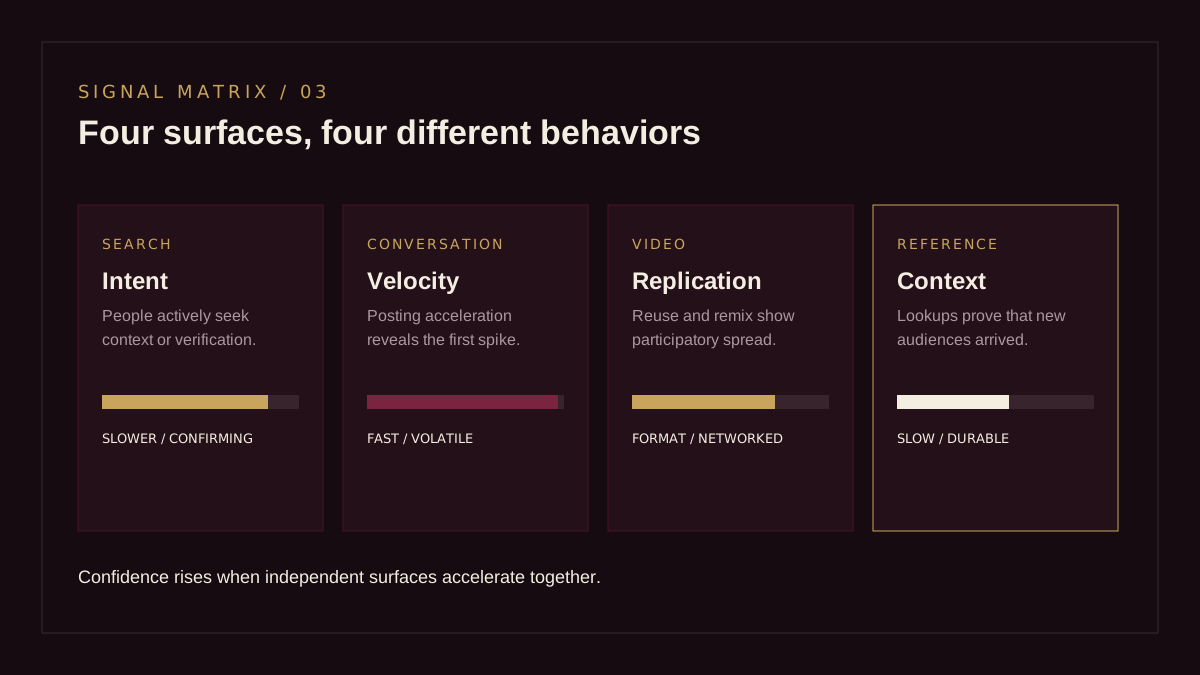
Anyone asking what is trending now worldwide is really asking four or five different questions at once. Every platform keeps its own ledger of attention, ranks it by its own rules, and shows a different slice of the result to every user. There is no master list — only overlapping surfaces that occasionally agree.
That disagreement is not a flaw. It is the most useful signal available. When TikTok, X, YouTube and Google Trends all surface the same subject within hours of each other, something genuinely global is happening. When a subject dominates one surface and is absent everywhere else, the trend is native to that platform’s mechanics — worth logging, but not worth mistaking for the world’s conversation.
WhoTalking maintains its live board on the front page precisely because of this fragmentation: the index reads across surfaces and markets rather than mirroring any single feed. This page explains the method — what each trending surface actually measures, why momentum matters more than volume, and how market context changes every reading.
What “trending” actually measures
A trend is not the biggest subject on the internet. It is the subject growing fastest against its own baseline. Most trending algorithms are built to detect acceleration — a sharp deviation from the expected level of posts, searches or views for a given term, at a given hour, in a given place.
Three variables sit underneath nearly every trending calculation:
- Volume — the raw count of posts, searches or views attached to a subject.
- Velocity — how quickly that count is rising or falling against the subject’s normal level.
- Breadth — how many distinct communities, regions and languages the subject is spreading across.
Platforms weight these differently, which is why the same hour produces different boards. A subject with enormous standing volume — a top footballer, a head of state, a mega-fandom — rarely trends on velocity-weighted surfaces, because its baseline is already high. A tiny subject can rocket up the same list on comparatively little activity, provided it started from zero.
The four surfaces, and what each one really ranks
TikTok: formats and sounds, not headlines
TikTok exposes no single, universal trending chart to regular users. Trends there travel as reusable material — a sound, a filter, an editing format, a challenge — and their scale shows in how many creators pick the element up, not in a ranked list. The platform’s Creative Center publishes trending hashtags and songs by country, but it is built for advertisers and lags behind the feed itself.
Reading TikTok therefore means watching reuse. A sound moving from a handful of niche creators into general-audience feeds within a day signals a format trend, and the nominal subject of any single video is often secondary. News and people do trend on TikTok, but they usually arrive wrapped in a format that carries them.
X: spikes, geography and conversation
X remains the fastest text surface, and its trends list is explicitly designed to favor what is popular right now over what has been popular for weeks. The list is computed per location and shaped by personalization, so two users in the same city can see different boards. Sharp spikes — a goal, a verdict, an on-air moment — dominate, while slow-building subjects rarely surface at all.
X is also the most market-uneven of the four. It carries outsized weight in Japan, where it remains a primary venue for entertainment and fandom conversation — a dynamic the Japan Entertainment desk tracks in detail — while in many other markets its role has narrowed toward news, sport and politics.
YouTube: slower curves, longer tails
YouTube runs on a slower clock. The platform has moved away from a single trending page toward category-level charts — music, gaming, film — which fits how attention actually behaves there: videos build over days, not minutes. A subject peaking on X at noon may not crest on YouTube until the explainers, reaction videos and highlight compilations land a day later.
That lag makes YouTube a confirmation surface. If a subject that spiked elsewhere never generates a second wave of YouTube coverage, the original trend was thinner than it looked.
Google Trends: intent, normalized
Google Trends measures something none of the feeds can: what people actively look up when no algorithm is pushing anything at them. Its numbers are not absolute counts — every figure is an index from 0 to 100, normalized to the selected time window and region — and its breakout label flags terms growing far beyond their baseline.
Search interest is the strongest evidence that a trend has escaped the feed. People search for what they intend to understand, verify, watch or buy. A subject with heavy feed volume but no search curve is being scrolled past, not engaged with.
Momentum versus volume: the core reading skill
The most common misreading of any trending board is treating position as size. Rank on a velocity-weighted list says a subject is accelerating; it says almost nothing about how big the subject is in absolute terms.
The desk separates every reading into three checks:
- Direction — is activity still accelerating, flat at a peak, or already decaying? Most trends spend more time decaying than rising, and a board freezes them at whatever moment it sampled.
- Baseline — how much attention does the subject command on an ordinary day? A spike on a high baseline moves whole markets of attention; a spike from zero is often a single viral object.
- Breadth — is the growth confined to one community and language, or crossing them? Cross-market confirmation is the difference between a fandom event and a world event.
Momentum without volume produces the classic one-day wonder: a clip, a quote, an unknown name that dominates a feed for a day and vanishes. Volume without momentum is the opposite case — the permanently famous, who anchor the People index for years while rarely appearing on spike-driven lists. The subjects worth flagging combine both: high-baseline names or stories that suddenly accelerate. When that happens, the movement almost always has a nameable cause — a release, a match, a verdict, an incident.
How markets change the reading
A global trending board is an abstraction. Attention happens in languages, time zones and platform cultures, and each market mixes them differently.
Platform mix is the first variable. X’s weight in Japan, YouTube’s reach in India, the centrality of WhatsApp and Instagram in Brazil — the same story enters each market through a different door. The second variable is the clock: a trend born in an American evening reaches Asian feeds during the working morning, and the reaction wave lands hours later with local framing. The third is the local event stack — elections, festivals, league fixtures — which occupies the top of every national board and pushes global stories down the list.
This is why the index treats “worldwide” as a claim to verify, not a label to trust. A subject trending in one language is a market story. A subject trending across several unrelated markets in the same window is the rarer, more valuable event. Conversations that sustain themselves across markets graduate from the live board to the Topics desk, where the index tracks them as ongoing files rather than momentary spikes. Fast-burning, platform-native material goes to the Viral ledger instead.
A reading protocol
Applied in order, five checks turn any trending list from a curiosity into usable information:
- Source the spike. Identify the originating platform and the specific post, clip or event behind it. Anything that cannot be traced within a few minutes deserves skepticism.
- Check a second surface. Confirm whether the subject registers anywhere its origin platform’s mechanics do not reach. Search interest is the strongest second witness.
- Establish the baseline. Decide whether this is a known quantity accelerating or an unknown starting from zero; the two have very different life expectancies.
- Locate the market. Determine which countries and languages are actually carrying the volume before accepting any worldwide framing.
- Time-stamp the phase. Judge whether the curve is rising, peaking or decaying. Arriving at a trend during its decay is the norm, not the exception.
None of these checks requires privileged data. They require only the discipline of treating every trending list as a measurement with known biases — which is how WhoTalking reads them, hour by hour, across every market the index covers.
Frequently asked questions
Why do trending lists differ from country to country?
Most platforms compute trends per region and language, then personalize the result for each user. Local calendars, local platform preferences and time zones do the rest. Identical boards in two markets are the exception, not the rule.
Is anything ever genuinely trending worldwide?
Yes, but rarely. Scheduled global events — a World Cup final, a major award show, a franchise premiere — and sudden hard news are the main categories that cross most markets in the same window. Most “global” trends on a single platform are large-market trends wearing a global label.
Why does a topic trend on X but not on TikTok?
Different mechanics. X detects text-volume spikes around named subjects, while TikTok trends travel as reusable sounds and formats. A news event with no visual format can own X and never register on TikTok, and a sound trend can do the reverse.
What does a Google Trends score of 100 mean?
Only that the term reached its peak search interest within the selected time range and region. The scale is relative, not absolute — a 100 for a niche term can represent a small fraction of the searches behind a 40 for a global one.
How fast do trends die?
Feed trends typically decay within hours to a couple of days once the driving event ends. Search interest holds somewhat longer, and YouTube coverage longest. Trends with a scheduled cause — a series, a league season — re-spike on the calendar instead of dying.
Can trending lists be manipulated?
Coordinated posting, fan streaming drives and paid amplification all attempt it, and platforms counter with spam filtering and ranking rules. The practical defense for a reader is cross-surface confirmation: manufactured momentum rarely survives outside the platform where it was organized.
Why do celebrity names trend with no news attached?
Usually an anniversary, a resurfaced clip, a fan campaign or an algorithmic echo of an older post. High-baseline names need very little new fuel to spike, which is why the index checks for a nameable cause before logging a movement.
What is the difference between trending and viral?
Trending describes rank on a platform’s list at a moment in time. Viral describes a propagation pattern — one object copied and reshared across accounts and platforms. Viral objects often cause trends, but most trending subjects are not viral objects.
Which surface is the best single indicator?
For confirmed public interest, search data — actively looking a subject up is harder to fake and slower to decay than feed volume. For early detection, the fast feeds win. No single surface is sufficient on its own, which is why the index reads all of them together.