Takuya Kimura: Japan’s Constant on the Attention Index
From SMAP to record-setting dramas and a durable solo career, Takuya Kimura remains the fixed point of Japanese celebrity attention.
For three decades, Japanese media has organized itself around a short list of constants, and Takuya Kimura sits near the top of it. Known nationwide as KimuTaku, he has held leading-man status in television, film and music since the early 1990s — a run of sustained domestic attention with few parallels anywhere in the index.
The SMAP era
Kimura rose as a member of SMAP, the five-man group that debuted in 1991 and became one of the best-selling and most influential acts in Japanese pop history. SMAP redefined what an idol group could be, fronting the long-running prime-time variety show SMAP×SMAP while its members built individual acting careers. The group’s disbandment at the end of 2016 was treated as national news, and its former members have remained central media figures since.
Ratings that defined an era
Kimura’s television run from the mid-1990s onward set commercial benchmarks Japanese broadcasters still cite. Long Vacation in 1996 was a social phenomenon; Love Generation and Beautiful Life followed; and the 2001 legal drama HERO posted some of the highest ratings of modern Japanese television, later returning as a sequel series and feature films.
Voted Japan’s favorite man by the magazine anan year after year through the 1990s and 2000s, he also banked prestige work: the voice of Howl in Studio Ghibli’s Howl’s Moving Castle, a lead role in Wong Kar-wai’s 2046, and the immortal swordsman of Takashi Miike’s Blade of the Immortal.
The solo chapter
After SMAP’s end, Kimura converted group fame into a durable solo file. He kept fronting flagship dramas — BG: Personal Bodyguard, the restaurant drama Grand Maison Tokyo, the film Masquerade Hotel — and played Oda Nobunaga in the 2023 historical epic The Legend & Butterfly. His first solo album, Go with the Flow, entered Japan’s Oricon chart at number one in 2020, followed by Next Destination in 2022. His arrival on Instagram in 2020 was covered as news in itself, and the account quickly ranked among the country’s most-followed celebrity presences — confirmation that an audience built in the broadcast era had transferred intact to the feed era.
Kimura’s file sits in the People index; the wider system he anchors — dramas, agencies, idol economics — is covered on the Japan Entertainment desk.
Why the attention pattern lasts
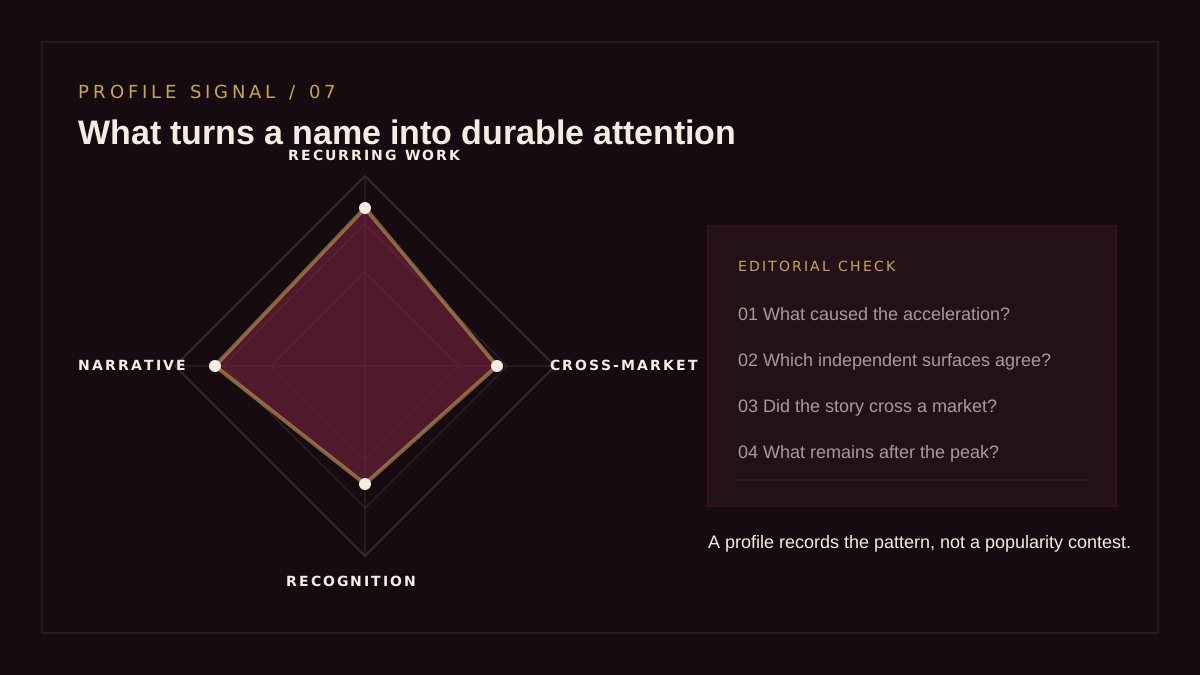
Takuya Kimura’s signal is built on intergenerational recognition. Long-running television visibility, the SMAP catalog, film roles and later solo work give different age groups distinct reasons to search and discuss the same name. In Japan, that breadth produces a stable baseline that can rise sharply around broadcasts, announcements or anniversary moments.
The global curve is narrower and more episodic because much of the source conversation remains Japanese. International discovery tends to arrive through subtitled drama circulation, games, film festivals and retrospective fandom rather than a synchronized worldwide release. That split is useful to the index: domestic scale and global reach are not treated as synonyms. Kimura’s profile shows why market context matters—an attention leader can be structurally central in one media system even when English-language trend boards capture only fragments of the underlying activity.