Anitta: How Brazilian Funk Reached the Global Feed
Anitta turned Rio funk into a trilingual global project and made herself Brazil's most reliable entry on worldwide attention boards.
Anitta is the clearest case in the index of an artist engineering her own market expansion. Born Larissa de Macedo Machado in Rio de Janeiro in 1993, she turned a domestic funk carioca career into a trilingual global project — and made herself the most reliable Brazilian entry on worldwide attention boards.
From Rio funk to national fame
Anitta sang in a church choir in the city’s north zone before Rio’s funk circuit picked her up. She broke nationally in 2013 with “Show das Poderosas,” whose video made her a household name in Brazil ahead of her debut album the same year. She consolidated the position deliberately: the 2017 hit “Vai Malandra,” filmed in the Vidigal favela, doubled as a statement that she would carry funk’s aesthetics with her rather than trade them away, and the 2018 Netflix docuseries Vai Anitta put her working method on international screens.
The trilingual playbook
Her expansion strategy was explicit: record in Portuguese, Spanish and English, and pair with established stars in each target market — Major Lazer on “Sua Cara,” J Balvin on “Downtown,” Madonna on “Faz Gostoso.” The approach peaked in 2022, when “Envolver” reached number one on Spotify’s global daily chart, a first for a Brazilian solo artist.
The same year brought a Coachella performance and the MTV Video Music Award for Best Latin — the first VMA won by a Brazilian act — followed by a Grammy nomination for Best New Artist. The albums Versions of Me and Funk Generation carried the run forward, the latter built squarely on the funk sound she started with.
Business on her own terms
Anitta’s attention profile is inseparable from her reputation as an operator. She managed key stretches of her own career, negotiated her own international deals, and served on the board of directors of Nubank, one of Latin America’s largest digital banks. At home she remains a fixture of Rio’s Carnival, where her appearances draw street crowds on a civic scale — a scheduled, predictable spike the board can pencil in every year.
Her file sits in the People index; the mechanics behind release-driven spikes like hers are explained on the Trending desk.
Why the attention pattern lasts
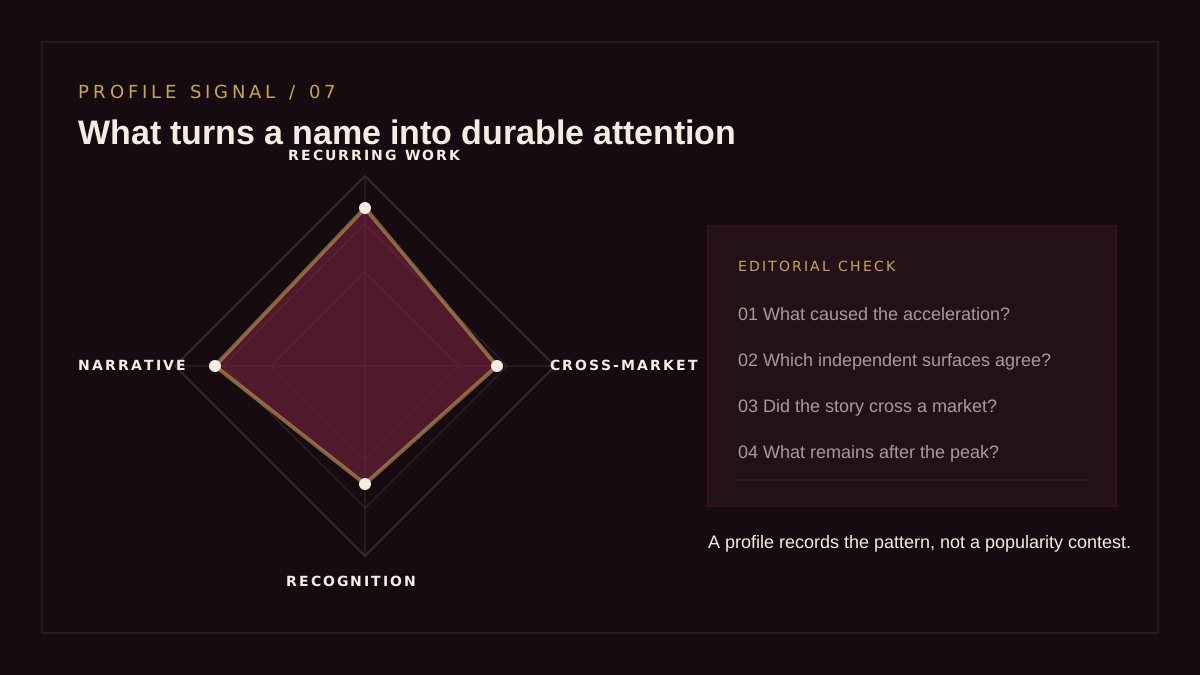
Anitta’s durable signal is not one crossover single but a repeatable route between markets. A Brazilian release can begin inside a Portuguese-speaking audience, pick up through dance and creator networks, and then gain a second life through Spanish- or English-language collaborations. Each stage introduces the catalog to a different public instead of asking one campaign to reach everyone at once.
That route also explains why her attention curve is unusually resilient. Music releases create the initial peak, but festival appearances, fashion coverage, business decisions and collaborations keep the name circulating between cycles. For the index, the important evidence is independent confirmation: domestic conversation, international search interest and short-video reuse rising together. When those signals separate, the story remains regional; when they align, the profile moves back into the global ledger.