Japanese Entertainment: Inside Japan’s Attention Market
A desk-level briefing on how Japanese entertainment converts domestic fandom into global attention, from anime openings turned TikTok sounds to X's Japan-first culture.

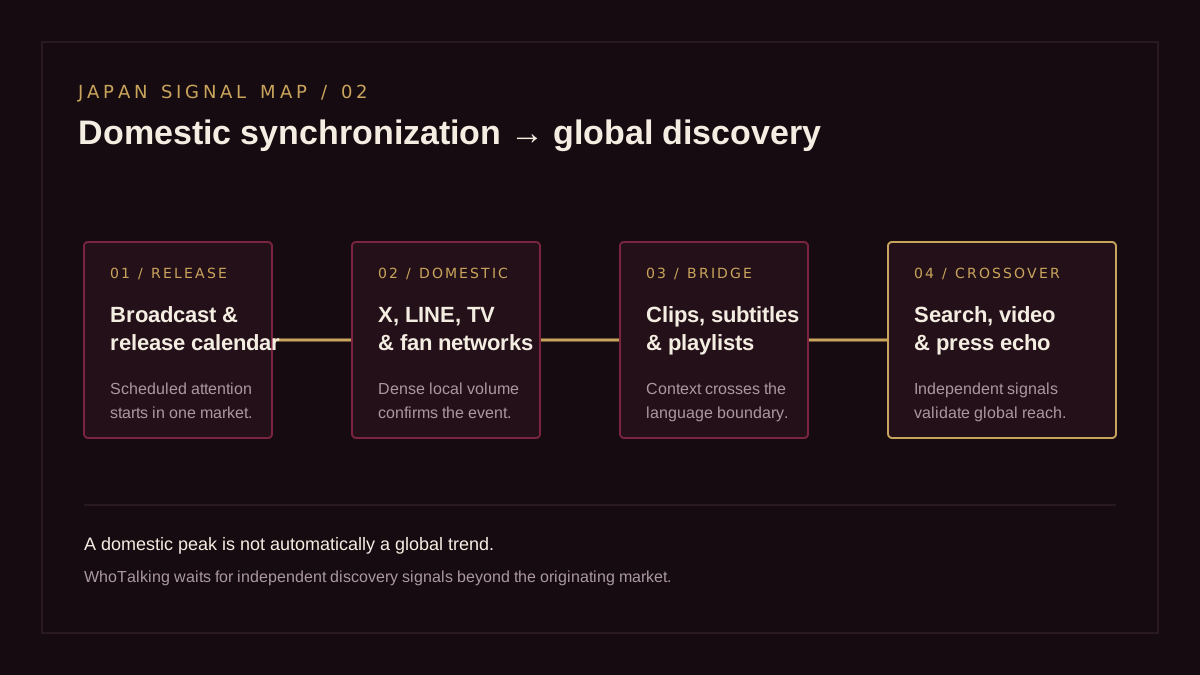
Japanese entertainment is the largest non-English attention economy on the planet, and for most of its history it was measured badly or not at all. Western charts logged what crossed over; everything else stayed invisible. That era is over. Anime now sits in the default watchlist of global streaming, Japanese-language songs top worldwide charts, and forty-year-old Tokyo pop records resurface as TikTok sounds. The signal volume coming out of Japan has never been higher — or easier to misread.
This page is the reference briefing for the WhoTalking Japan desk. It explains how the Japanese entertainment industry is structured, why some of its output travels and some deliberately does not, and which signals the trending board watches when a Japanese property starts moving.
Why Japanese Entertainment Travels Globally Now
Three inputs explain the shift, and all three are infrastructure rather than fashion.
First, streaming removed the distribution bottleneck. For decades, Japanese studios licensed anime abroad slowly and regionally; simulcasting inverted that. Crunchyroll — acquired by Sony and merged with Funimation — passed fifteen million paying subscribers, and Netflix treats anime as a core acquisition category rather than a niche shelf. A new series now premieres worldwide within hours of its Tokyo broadcast, which means global fan conversation and Japanese fan conversation run on the same clock for the first time.
Second, the anime boom crossed from subculture to mainstream measurement. Demon Slayer: Mugen Train became the highest-grossing Japanese film in history during a pandemic year. Godzilla Minus One took the Academy Award for Best Visual Effects. The Boy and the Heron won Hayao Miyazaki his second Oscar for Best Animated Feature. Shōgun — a Hollywood production built on Japanese source material, language, and casting — swept a record eighteen Emmys for a single season. The pattern behind these separate events is the same: Japanese aesthetics and Japanese-language performance no longer carry a crossover penalty.
Third, catalog revival turned Japan’s archive into a renewable attention asset. The city-pop revival — Mariya Takeuchi’s 1984 track “Plastic Love” becoming a YouTube recommendation phenomenon, Miki Matsubara’s 1979 “Mayonaka no Door / Stay with Me” leading Spotify’s global viral chart four decades after release — proved that Japanese back catalog can chart without any new marketing spend.
One more structural note: what travels is increasingly Japanese style, not just Japanese intellectual property. Western pop borrows anime visual language, game-soundtrack textures, and Tokyo streetwear codes even when no Japanese rights holder is involved. That makes the market bigger than its export ledger suggests.
J-Pop and Idol Culture: The Agency System and the New Breakthroughs
Japanese music does not run on the free-agent logic of the American market. It runs on the jimusho — the talent agency — which historically controlled recruitment, training, bookings, image rights, and media access. Understanding the agency layer is the single highest-value piece of context for reading any Japanese celebrity story.
The idol economy
Idols are performers marketed on accessibility and continuous fan relationship rather than virtuosity. The model AKB48 industrialized from 2005 — a dedicated theater, rotating line-ups, handshake events, and singles bundled with event tickets — made the CD a membership token rather than a music format. That is why Japan remains the world’s second-largest recorded-music market with an unusually resilient physical segment: fans buy multiples to vote, to meet, to support. The Sakamichi groups (Nogizaka46, Sakurazaka46, Hinatazaka46) refined the same architecture with glossier production.
On the male side, one agency — Johnny & Associates — dominated idol production for half a century. After the abuse revelations surrounding its late founder became undeniable in 2023, the company renamed itself SMILE-UP. to handle compensation, and talent management moved to a new firm, STARTO ENTERTAINMENT. The restructuring cracked open a booking system that had governed Japanese television casting for generations, and its aftershocks still shape who appears where.
The breakthrough pattern
The artists who now break globally mostly route around that legacy system, and their careers follow a documented sequence. YOASOBI, a duo that adapts short fiction into songs, saw “Idol” — the opening theme for the anime Oshi no Ko — become the first Japanese-language song to top Billboard’s Global Excl. U.S. chart. Ado, who performs unseen behind silhouettes and lighting rigs, topped Billboard Japan’s Hot 100 with “Usseewa” while still in her teens, then supplied the singing voice of Uta in One Piece Film: Red and pushed its songs to the top of global streaming charts. Kenshi Yonezu built his first audience as the Vocaloid producer Hachi on NicoNico before “Lemon” became a generational hit. Fujii Kaze watched a two-year-old album track, “Shinunoga E-Wa,” go viral on TikTok across Asia and far beyond it.
Read the pattern: internet-native origin, anime or short-video attachment, global chart entry, then a world tour. The order almost never varies, and it is the sequence the people index uses to distinguish a domestic star from a crossover in progress.
Anime and Its Celebrity Ecosystem
Anime is not only a content category; it is a celebrity-manufacturing system with its own stars, labels, and economics.
Seiyuu — voice actors — occupy a fame tier that has no Western equivalent. They host radio shows, front magazine covers, release albums, and headline concerts. Idol-anime franchises such as Love Live! fill arenas with live shows performed by the characters’ voice casts. The anisong circuit (anime theme-song performance) is a career track of its own: LiSA’s “Gurenge,” the Demon Slayer opening, became one of the most-streamed Japanese songs of its era and made her a household name far outside anime fandom.
Studios function as public brands in a way Western animation houses rarely do. Studio Ghibli is a global heritage marque. Ufotable’s digital compositing defined the look of Demon Slayer; MAPPA’s production slate (Jujutsu Kaisen, Chainsaw Man, the final seasons of Attack on Titan) is followed and debated like a sports roster; Kyoto Animation’s craftsmanship commands a loyalty that survived tragedy. Directors carry celebrity too — Makoto Shinkai’s Your Name became a worldwide box-office event in 2016 and turned his name into a genre label.
Underneath sits the seisaku iinkai — the production committee — a consortium of broadcaster, publisher, music label, and merchandiser that co-finances a series and splits its rights. The committee system spreads risk, which is why so much anime gets made, and fragments ownership, which is why licensing and music clearances move slowly. When a clip goes viral and the full song takes days to appear on Western platforms, the committee structure is usually the reason.
Japanese TV and Tarento Culture: Why It Stays Home
Japanese television is enormous, profitable, and almost entirely domestic — the deliberate inverse of anime’s export posture.
Its cast system is built on the tarento (from the English word “talent”): personalities who circulate across variety shows, quiz panels, travel programs, and commercials, famous less for one craft than for reliable on-screen presence. The pipeline that feeds them runs through owarai — comedy — and above all through Yoshimoto Kogyo, the century-old Osaka agency with thousands of comedians under contract. Agencies package their rosters into programs through long-standing relationships with broadcasters, which is why the same faces appear across every network in the same week.
Why does none of this travel? Structurally, it cannot. Variety formats are built on rapid wordplay, manzai comedy timing (a two-person straight-man/funny-man form), and shared domestic references that subtitles flatten. The economics are broadcast-first: a tarento’s income comes from volume of appearances and endorsements, not from international syndication. And the New Year’s Eve institution Kōhaku Uta Gassen — NHK’s song contest, running since 1951 — shows how self-contained the ecosystem is: an invitation remains a career-defining honor with essentially no meaning outside Japan.
The exceptions prove the rule and run through Netflix: Alice in Borderland traveled globally as a scripted thriller, First Love found an international audience, and Old Enough! — a decades-old format in which toddlers run small errands — became a Western word-of-mouth hit precisely because its premise needs no cultural translation. Streamers export Japanese television selectively; broadcast television barely exports at all.
How Japanese Trends Cross Over: The Pipeline
Crossover looks sudden. It is not. Nearly every Japanese property that breaks internationally moves through the same relay, and each leg emits signals a tracker can log before the next.
The canonical current example: Creepy Nuts’ “Bling-Bang-Bang-Born,” the opening for Mashle season two, spawned a shoulder-rolling dance meme that saturated TikTok within weeks, then carried the full track onto Billboard’s global charts. The city-pop revival ran the same relay in reverse chronology — old masters, new clips. Game music runs a parallel track: Final Fantasy’s Distant Worlds concert series has toured internationally for years, while Persona and NieR soundtracks circulate through playlists and fan edits. Even virtual performers follow the route — Hatsune Miku, the Crypton Future Media vocal synthesizer turned concert act, played Coachella in 2024.
| Stage | Mechanism | Documented example |
|---|---|---|
| 1. Domestic launch | Single, album, or anime broadcast lands in Japan; Oricon and Billboard Japan register first movement | “Bling-Bang-Bang-Born” premieres as the Mashle season-two opening |
| 2. Sync attachment | The song binds to an anime opening, film, or game — a visual carrier with built-in global reach | YOASOBI’s “Idol” opens Oshi no Ko; Ado voices Uta’s songs in One Piece Film: Red |
| 3. Short-video lift | A 15–60 second excerpt becomes a TikTok or Shorts sound; dance and meme formats multiply usage outside Japan | The “BBBB” dance; “Mayonaka no Door” resurging on TikTok in 2020 |
| 4. Global chart entry | Full-track streaming converts; viral charts first, then the Billboard Global 200 tier | “Idol” topping Billboard Global Excl. U.S. |
| 5. Platform canonization | Official uploads, translated lyric videos, and editorial playlists consolidate the audience | Fujii Kaze’s “Shinunoga E-Wa” entering Spotify viral charts across regions |
| 6. Offline conversion | World tours, festival bookings, and catalog pull confirm a durable international fanbase | Ado’s sold-out international tour; Hatsune Miku at Coachella 2024 |
The viral tracker is calibrated to stage three: short-video lift is the earliest reliable indicator that a Japanese release has escaped its domestic container. By stage four, the move is public knowledge; by stage six, it is history.
The Japanese Attention Market vs. Western Markets
Reading Japanese celebrity data with Western assumptions produces systematic errors. Four norms differ at the root.
Agency control runs deeper. Japanese agencies traditionally hold image rights and mediate all press access. For years, some agencies barred official photos of their talent from appearing online at all — a policy that shaped Japanese web media into a text-first culture around celebrities. Unauthorized paparazzi economics exist, but the accommodation between agencies and mainstream media is far tighter than in the American market.
Privacy is a professional asset, not a sacrifice. Anonymity can be a strategy: Ado has built an arena-scale career without showing her face, and masked or faceless acts are an accepted category rather than a gimmick. Where Western stardom prices in personal exposure, Japanese stardom often prices in its absence.
The scandal mechanism is formalized. Weekly tabloid magazines break stories; the accused holds a press conference; the bow of apology is itself a measured media event. Sponsors and broadcasters react quickly, and idol contracts have historically included conduct clauses — dating bans among them — that would be unenforceable curiosities elsewhere. Attention spikes around Japanese scandals therefore follow a script, and the script itself is trackable.
Fan culture is participatory and codified. Oshikatsu — the organized activity of supporting one’s oshi, the favorite performer a fan champions — is a mainstream consumer category with its own retail economy: color-coded penlights, uchiwa (round hand fans) displayed at concerts, birthday café bookings, bulk purchases as voting. Filming at concerts is generally prohibited, the reverse of Western clip-everything norms, which is why Japanese live moments surface online as fan-drawn art and text reportage rather than shaky video.
Key Platforms: Where Japan’s Attention Actually Lives
Platform mix is the most common blind spot in Western coverage of Japan. The hierarchy is different, and the differences are load-bearing.
X (Twitter) is the public square. Japan has long ranked as the platform’s second-largest market after the United States, and its usage style — pseudonymous accounts, high posting frequency, fandom-organized hashtag culture — makes Japanese trends unusually legible there. The defining artifact: in August 2013, viewers of a television airing of Castle in the Sky simultaneously posted the film’s destruction spell, “balse,” producing 143,199 tweets per second — a record that stood for years. Japanese trending topics remain one of the highest-signal celebrity feeds in the world.
LINE is the private layer. Built in the aftermath of the 2011 Tōhoku earthquake, when phone networks failed and data survived, LINE became Japan’s default messenger and then a portal: news, payments, stickers as an expressive economy, official artist accounts as fan-club infrastructure. It shapes distribution more than discourse — a story that runs on LINE News reaches demographics X never touches.
NicoNico is the ancestor. The video site that launched in 2006 with comments scrolling over the footage itself incubated much of what now defines Japanese internet culture: Vocaloid music and Hatsune Miku fandom, the utaite scene of cover singers that produced Ado, and the producer culture that trained Kenshi Yonezu and YOASOBI’s Ayase. Its commercial weight has faded next to YouTube — now the dominant video platform in Japan as everywhere — but its conventions persist across the ecosystem it seeded.
The domestic streamers matter for television. ABEMA (a TV Asahi and CyberAgent venture) and the broadcaster catch-up service TVer moved Japanese TV consumption online without exporting it, while TikTok supplies the crossover bridge for music. Each platform occupies a lane, which is precisely why cross-platform measurement earns its keep.
How WhoTalking Covers the Japan Desk
WhoTalking operates as a global attention index: it logs who is being talked about, where, and with what velocity. Japan gets a dedicated desk because its signals are structurally separate — different platforms, different charts, different celebrity mechanics — and because naive global aggregation consistently underweights them.
The desk’s method follows the pipeline described above. Domestic inputs first: chart movement on Oricon and Billboard Japan, Japanese trending topics on X, and search-interest deltas inside Japan. Crossover inputs second: short-video sound velocity outside Japan, global viral-chart entries, Wikipedia traffic in non-Japanese languages, and international booking announcements. When the two signal families converge on one name, that name moves up the front-page index and gets a profile entry in the people ledger.
Coverage is organized the same way as the rest of the site: individual figures are filed under people, breakout moments under viral, and recurring subjects — anime, J-pop, idol groups, studios — under their own topic pages. The trending board carries the live view; this page carries the context that makes the live view readable.
Frequently Asked Questions
What counts as Japanese entertainment?
The umbrella covers anime, manga, J-pop and idol music, television drama and variety, film, video games, Vocaloid and VTuber culture, and the celebrity ecosystem around all of them. The segments share agencies, platforms, and fan practices, which is why analysts treat Japanese entertainment as one interlocking market rather than separate industries.
Why is Japanese pop culture so popular around the world?
Distribution caught up with demand. Streaming services made anime and Japanese music instantly available worldwide, short-video platforms turned songs and dances into borderless formats, and decades of manga and game fandom had already built a literate global audience. Add a deep back catalog that algorithms keep rediscovering, and the growth compounds.
How is J-pop different from K-pop?
K-pop was engineered as an export product: English hooks, global social-media operations, international trainees. J-pop historically optimized for the domestic market — the world’s second-largest — with CD-era fan economics and agency-controlled media. That is changing as acts like YOASOBI and Ado chart globally, but the default posture still differs: K-pop pushes outward, J-pop pulls inward.
What is an idol in Japanese entertainment?
An idol is a performer marketed on closeness and continuous fan relationship — theater shows, handshake and photo events, merchandise cycles — rather than purely on musical output. Idol careers are agency-managed and image-controlled, and fan purchasing doubles as participation: buying multiple CDs to vote in line-up decisions is a designed feature of the model.
What is the jimusho (agency) system?
Jimusho are talent agencies that scout, train, and manage performers while controlling their image rights and media bookings. Broadcasters cast through agency relationships, which gives large jimusho enormous gatekeeping power. The 2023 collapse of Johnny & Associates into SMILE-UP. and STARTO ENTERTAINMENT showed both the system’s scale and its capacity for reform under pressure.
What is a seiyuu, and why do voice actors sell out arenas in Japan?
Seiyuu are voice actors, and in Japan they are celebrities in their own right: they release music, host radio programs, and front live events. Franchises such as Love Live! stage arena concerts performed by the voice casts of their characters. Anime’s cultural centrality makes the voice behind a beloved character a star in a way Western markets rarely replicate.
What is a tarento, and why do they rarely appear outside Japan?
A tarento (from “talent”) is a television personality who circulates across variety shows, panels, and commercials. Their value rests on domestic familiarity and Japanese-language wordplay, and their income comes from appearance volume and endorsements rather than exportable programming. The format itself does not translate, so the careers built on it stay home.
Which Japanese song first topped a global Billboard chart?
YOASOBI’s “Idol,” the opening theme of the anime Oshi no Ko, became the first Japanese-language song to reach number one on Billboard’s Global Excl. U.S. chart in 2023. The run demonstrated the modern crossover pipeline in full: anime sync, short-video saturation, then sustained global streaming.
What is city pop, and why did it come back?
City pop is the polished, groove-driven Japanese pop of the late 1970s and 1980s — Mariya Takeuchi, Tatsuro Yamashita, Miki Matsubara. Its revival was algorithmic: YouTube recommendations turned “Plastic Love” into a phenomenon decades after release, and TikTok later carried “Mayonaka no Door / Stay with Me” up Spotify’s global viral chart. No label campaign was involved.
Why do some Japanese artists perform anonymously?
Anonymity is an accepted artistic register in Japan, rooted in Vocaloid and utaite (cover-singer) culture, where the voice mattered more than the face. Ado carries that norm to arena scale, performing behind silhouettes. Anonymity also preserves private life in a market where agencies and tabloids police celebrity conduct closely — invisibility can be both aesthetic and armor.
Why is X (Twitter) unusually strong in Japan?
Pseudonymous posting suits Japanese privacy norms, the platform fits fast fandom coordination, and its role as a real-time public square was cemented early — including during disasters. Japan has long been the platform’s second-largest market, and events like the 2013 “balse” moment, at 143,199 tweets per second, remain landmarks of collective posting behavior.
What role does LINE play in Japanese media?
LINE is Japan’s default messenger and one of its biggest news distribution channels. Built after the 2011 earthquake exposed the fragility of phone networks, it evolved into a portal spanning news, payments, and official artist accounts that function as fan-club infrastructure. It moves stories to audiences that public social feeds never reach.
What is NicoNico, and why does it matter historically?
NicoNico is the 2006-vintage video platform whose scrolling on-screen comments defined Japanese internet culture. It incubated Vocaloid music, Hatsune Miku fandom, and the utaite cover-singing scene — the training grounds of Kenshi Yonezu, YOASOBI’s Ayase, and Ado. YouTube long since overtook it in reach, but its creative conventions still shape Japanese online media.
What is oshikatsu?
Oshikatsu is the organized practice of supporting one’s oshi — the performer, character, or group a fan champions. It spans concert attendance with color-coded penlights and uchiwa fans, birthday café events, merchandise collecting, and bulk purchases that double as votes. In Japan it is a mainstream consumer category with measurable retail impact, not a fringe hobby.
Why does Japan still buy so many CDs?
Because the CD is a token as much as a format. Idol economics attach handshake-event tickets, voting rights, and collectible variants to physical singles, so committed fans buy in multiples. That design keeps Japan’s physical music segment unusually large and explains why Oricon’s physical-weighted charts and Billboard Japan’s blended charts can tell different stories about the same week.
How does an anime opening become a global hit?
The opening airs worldwide with the simulcast episode, a 15–60 second cut becomes a TikTok or Shorts sound, dance and meme formats multiply its usage, and full-track streaming then converts into viral-chart and global-chart entries. Creepy Nuts’ “Bling-Bang-Bang-Born,” the Mashle season-two opening, ran this exact sequence — meme first, Billboard after.
How does WhoTalking track Japanese entertainment signals?
The Japan desk pairs domestic indicators — Oricon and Billboard Japan chart movement, Japanese X trends, in-country search interest — with crossover indicators such as short-video sound velocity abroad, global viral-chart entries, and non-Japanese Wikipedia traffic. Names where both families of signals converge are promoted on the trending board and filed under people, viral, and topic pages for continuity.