Trending People on Social Media: Who Holds Global Attention
A category-by-category analysis of the public figures who dominate social platforms — and the mechanics, regions, and cycles that decide how long they hold attention.

Trending people on social media are the most legible real-time record of where collective attention actually goes — not where audiences claim it goes. Every major platform runs its own version of the measurement: trending panels, For You distribution, front-page ranking, hashtag velocity. Read together, those signals form a single index of person-level attention, and reading them together is the discipline behind the global attention index.
Most coverage of this subject takes the form of lists — most-followed accounts, top-influencer rankings, annual best-of roundups. Lists answer who, and they expire the day they publish. This reference documents the system instead: which categories of people trend, the platform mechanics that decide who surfaces, how the cast changes by country, and how long person-level attention actually lasts once it peaks.
Treat this page as the reference layer for the People section. Definitions come first, mechanics second, patterns third, and a full question bank closes the file.
Who Counts as a Trending Person Now
A trending person is a public figure whose name produces a measurable, time-bound surge of posts, searches, and engagement — on at least one major platform, and usually on several at once. The operative unit is the spike, not the audience. A person does not trend by being large; a person trends by moving.
That distinction separates two measurements that casual coverage constantly merges. Follower counts are stock: audience accumulated over years. Trending status is flow: attention moving right now. The most-followed accounts on Earth can sit dormant for weeks while a figure with a fraction of their audience dominates a full news cycle. An accurate index tracks the flow and treats the stock as context.
Four categories supply the overwhelming majority of person-level trending events.
Entertainers
Musicians, actors, and television personalities trend on a release calendar. Albums, films, premieres, tours, and award season deliver attention on schedule, which makes entertainer spikes the most predictable in the entertainment economy. Organized fandoms add a second layer: coordinated hashtag campaigns, streaming pushes, and anniversary celebrations that manufacture spikes between releases. No other category has audiences that generate trends on the subject’s behalf so reliably.
Athletes
Athletes are fixture-driven, and fixtures are published months in advance. Match days, finals, championship runs, transfer windows, and Olympic cycles convert performance into attention within minutes of the whistle. The pattern is high-frequency and rhythmic: a footballer in a top league can trend forty times in a season without a single off-field story. Long careers build deep attention baselines that outlast retirement.
Politicians and Public Officials
Political figures trend on statements and events — elections, debates, policy announcements, confrontations, and gaffes. Polarization doubles the engagement mechanically: supporters amplify in defense while opponents amplify in attack, and the trending system counts both directions as the same signal. Political attention runs in election-cycle waves, with off-cycle spikes driven almost entirely by controversy.
Creators
Creators are platform-native figures whose fame originates inside the feed rather than in any external institution. They replace the release calendar with upload cadence and trend on collaborations, feuds, milestones, format experiments, and platform drama. The category has the highest churn of the four: names rise and exit the trending population faster than in any institutional domain, because the distribution that made them is rented, not owned.
Names that trend outside these four categories — bystanders, litigants, interview subjects, anonymous accounts caught in a storm — are usually event-attached rather than person-attached. Their attention belongs to the event and decays with it, which is why the index files those cases in the viral moments ledger rather than in the People records.
The Platform Mechanics That Make People Trend
Two engines produce person-level trending, and they operate on different logic.
The first engine is algorithmic amplification. Recommendation feeds — the For You page model — distribute content on predicted engagement rather than on follower graphs. When early viewers watch, share, and comment at unusual velocity, the system widens distribution in steps, and a person attached to that content can reach tens of millions of viewers who never chose to follow anyone involved. This engine manufactures new trending people from a standing start, which no broadcast-era mechanism could do.
The second engine is the news cycle. Trending panels, front-page ranking systems, and live-event hashtags aggregate what large numbers of people post about simultaneously. This engine does not create attention; it mirrors and accelerates it. Breaking news, live sport, televised ceremonies, and political developments push established figures up these lists within minutes.
The two engines compound each other. A feed-driven surge attracts press coverage; press coverage drives search; search volume feeds the recommendation systems again. That loop — feed to press to search to feed — is the multiplier that turns a platform moment into a cross-platform trending event, and its presence or absence is the best single predictor of whether a spike lasts one day or one week.
Platform architecture then decides who benefits. Each network favors a different kind of person and imposes a different decay rate on the attention it grants.
| Platform | Who tends to trend there | Typical attention half-life |
|---|---|---|
| TikTok | Platform-native creators, musicians during sound-driven surges, previously unknown people surfaced by the For You feed | Short — hours to a few days; distribution moves on quickly once engagement velocity drops |
| YouTube | Creators with deep back catalogs, musicians at release, long-form commentators and interviewers | Long — weeks to months; search and recommendation keep routing viewers to the same videos |
| X | Politicians, athletes on match days, anyone at the center of breaking news or live events | Very short — hours; trending lists turn over with the news cycle itself |
| Entertainers, athletes, and lifestyle figures making announcements to established audiences | Medium — days; attention is anchored to the follower graph and fades with posting rhythm | |
| Niche experts, fandom subjects, and figures at the center of controversy or community debate | Medium to long — days to weeks; archived threads resurface through search and reposts |
These half-lives are typical ranges, not constants: a strong second development resets any clock, and a weak trigger can die in an hour on every platform. Current movers across all five networks are consolidated in the live trending ledger, which is the fastest way to see the engines described here operating on today’s names.
Regional Differences: United States, Japan, Brazil, France
The mechanics above are global. The casts are not. The same algorithms, pointed at different media systems, produce structurally different trending populations — and a “worldwide” trending list is usually an anglosphere list wearing a global label. Four markets illustrate the spread.
United States
The American trending population draws from the deepest celebrity infrastructure in the world: film and music industries with global reach, four major sports leagues with daily fixtures, a presidential political system built for televised conflict, and the largest creator economy anywhere. Award season and championship games anchor the calendar; political figures trend year-round at intensities most countries reserve for elections. American trending names also export: the rest of the world absorbs a large share of American attention cycles, while the reverse rarely happens.
Japan
Japan’s trending ecosystem is idol-centric and text-heavy. J-pop groups run structured announcement cycles — debuts, singles, member graduations, group reorganizations — that trend nationally with clockwork reliability, and a member’s departure can dominate the conversation for days. Anime voice actors, seiyu, trend on casting announcements in a way that has no Western equivalent, and television tarento sustain steady baseline attention across decades. X occupies an unusually central position in Japanese online life, which makes Japan one of the most measurable attention markets on Earth. The index covers this market separately in its Japan entertainment hub, because the cast, the calendar, and the platform mix all diverge from Western defaults.
Brazil
Brazil runs on futebol as its default attention engine: match days, continental finals, national-team drama, and transfer sagas involving Brazilian players abroad all trend with enormous volume. Reality-television franchises add a distinctive second engine — months-long formats that push contestants into daily national trends for an entire season. Brazilian fan communities are famously coordinated and routinely push their idols, domestic and foreign, into global trending lists through sheer organized volume. Political polarization supplies the third engine, with public figures trending through confrontation much as they do in the United States.
France
France trends its politicians with unusual intensity: a debate-centric media culture and a two-round presidential system keep political figures in rotation well beyond election windows. Footballers form the second pole of French attention. Rap — the country’s dominant popular music — supplies a creator-adjacent trending class with its own feuds, releases, and platform dynamics. And France retains a pattern most markets have lost: public intellectuals and broadcast polemicists still trend on the strength of an argument, a survival of an older media culture inside a new distribution system.
The practical conclusion for any analyst: read regional ledgers separately. Aggregated global lists over-weight English-language volume and systematically miss the idols, footballers, and polemicists who dominate their home markets.
How Long Person-Level Attention Lasts
Attention decay is measurable, and the useful metric is the half-life: the time engagement takes to fall to half its peak. Person-level spikes resolve into three duration classes.
The moment lasts hours to a few days. One trigger, one spike, standard decay. Most trending events belong here, and most leave no residue: the name returns to its prior baseline as if the spike never happened.
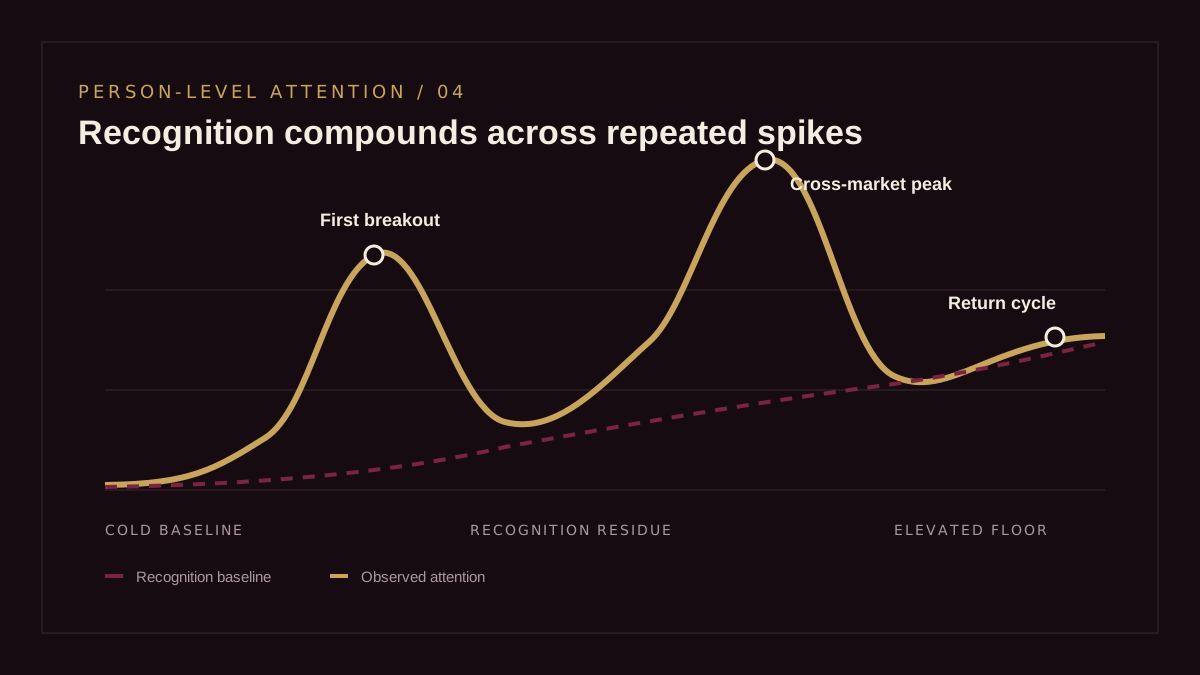
The cycle lasts weeks. A connected series of developments — an award season, a title race, a court case, a public dispute — renews the spike before it fully decays, producing a sawtooth pattern of linked peaks. Cycles are where reputations move, because audiences form durable impressions through repetition, not through single exposures.
The elevation is permanent. Occasionally a cycle ends with the baseline resettling higher than where it started: the person has become a standing character in the public conversation, referenced even in weeks without news. Elevation is the rarest outcome and the only one that changes a person’s long-term attention economics.
Person-level attention also behaves differently from event-level attention in one structural way: people can re-enter, events cannot. An event spikes once and archives. A person accumulates — every new spike builds on the recognition deposited by the last one, which is why person attention rewards ledger-style tracking. Each spike is an entry; the profile is the running balance.
Creator Economy vs Institutional Fame
Two production systems currently manufacture famous people, and they generate different trending behavior.
Institutional fame is the legacy system: studios, labels, leagues, parties, and broadcasters select a small number of people and invest heavily in each. Distribution arrives through owned channels and press relationships. The result is durable, campaign-based attention — institutional figures trend less often, but their spikes are larger, their baselines deeper, and their careers longer. The institution absorbs platform risk on the person’s behalf.
Creator fame is platform-native. Selection is algorithmic, investment is the creator’s own labor, and distribution is rented from recommendation systems that owe nothing to anyone. Creators trend far more frequently — cadence is the entire strategy — but hold the platform risk personally: a distribution change can halve a creator’s reach in a month without any change in output quality. Creator attention is high-frequency, low-security; institutional attention is the reverse.
The two systems are converging from both directions. Athletes run vlogs, politicians stream, and studios cut feature films into vertical clips — institutions executing creator playbooks. Meanwhile successful creators institutionalize: production companies, product lines, podcast networks, broadcast deals. The categories blur at the top, but origin still predicts behavior — trend cadence, decay rate, and career risk all track where a person’s fame was manufactured, which is why the index records origin as a core attribute of every profile.
Recurring Case Patterns
Day to day, person-level trending looks chaotic. Over long observation windows it resolves into repeatable shapes. Three patterns dominate the annual calendar, and each runs on schedule regardless of which names fill it.
The Award-Show Spike
Award ceremonies are the rare pattern that spikes an entire category at once. The choreography is fixed: nominations trend the shortlist weeks ahead; the ceremony itself trends winners, snubs, red-carpet looks, and speech clips in real time; the following two days trend reaction, commentary, and re-cut highlights. Attention distributes across dozens of names simultaneously, and the biggest single beneficiary is often not the biggest winner but the owner of the most clippable moment.
The Transfer-Window Spike
Football’s transfer windows run an attention economy on speculation alone. For weeks, the same names recur in low-grade daily trends fed by rumor accounts and aggregation media; the official announcement produces the peak; the unveiling and debut produce the echo. The structural anomaly is that the spike precedes the event — a player can be among the most-discussed people in sport for a month before anything actually happens. Draft nights and trade deadlines in American leagues run the same shape on a compressed clock.
The Scandal Cycle
The trigger is unpredictable; the shape never is. An allegation surfaces and spreads on outrage velocity. The pile-on phase follows, where commentary volume dwarfs the original story. The response — apology, denial, silence — produces a second spike, and commentary on the response produces a third. A residual search tail then persists long after posting volume dies. Scandal converts attention into permanent baseline more reliably than positive news does, because controversy is endlessly re-citable: every future mention of the name carries the episode with it.
These patterns are generic by design. The names change every season; the shapes repeat so consistently that an analyst can model the attention curve of an award night or a transfer deadline before knowing who will occupy it. Event-level anatomies of individual eruptions — the single moments rather than the recurring calendars — are documented case by case in the viral files, and thematic threads that cut across many people at once are organized in the topic index.
How WhoTalking Profiles People
Not every trending name earns a People entry. The index applies fixed editorial criteria before a person enters the files, and the criteria are published so the selection logic stays inspectable.
- Cross-platform confirmation. Signal must appear on at least two platforms. Single-platform spikes are usually artifacts of one algorithm rather than evidence of genuine public attention.
- Repeated attention. One spike is an event and belongs in the event files. A second independent spike establishes a pattern, and patterns are what person profiles exist to record.
- Regional weight. A figure who dominates one national conversation qualifies without any global footprint. The index deliberately corrects the anglosphere bias of aggregated lists.
- Category balance. Entertainers, athletes, political figures, and creators are tracked in deliberate proportion, preventing the entertainment monoculture that engagement-ranked coverage drifts toward.
- Context over volume. Every profile records why attention moved, not merely that it moved. Names that trend on pure noise, with no explicable driver, wait until the driver is identifiable.
Profiles are then maintained as ledger entries: baseline level, spike history, the driver behind each spike, observed half-lives, and platform distribution. The method stays deliberately boring — the same fields, updated the same way, for every person in the index — because consistent measurement is what makes one profile comparable to another.
Frequently Asked Questions
Who is the most trending person on social media right now?
There is no stable answer, and that is the point: trending status turns over daily. The names heading follower leaderboards — long dominated by global footballers such as Cristiano Ronaldo and Lionel Messi and pop figures such as Selena Gomez — measure accumulated audience, not current attention. On any given day, the most-trending person is usually whoever sits at the center of that day’s largest release, fixture, or controversy.
What is the difference between most-followed and most-trending?
Followers are stock; trending is flow. Most-followed rankings count audience accumulated over years and change slowly. Trending measures attention moving right now and can crown a different name every day. A mega-account can stay dormant for weeks while a far smaller figure dominates the conversation.
How does a person start trending on social media?
Through one of two engines, usually both: recommendation algorithms amplifying unusual engagement velocity, and news cycles aggregating simultaneous posting. The standard sequence is a triggering event, feed-driven distribution, press pickup, and search volume feeding back into the feeds. When that loop closes, a platform moment becomes a cross-platform trend.
How long does a typical trending spike last for a person?
It depends on the platform. Attention measured on X typically halves within hours, TikTok and Instagram within days, YouTube and Reddit over weeks. Most single-event spikes resolve within about seventy-two hours unless a second development renews them and converts the moment into a longer cycle.
Which platform is best for tracking trending people?
It depends on the question being asked. X surfaces news-driven and political attention fastest; TikTok reveals emerging creators before other platforms register them; YouTube and Reddit show which attention is durable rather than momentary. No single feed is sufficient, which is why serious tracking reads all of them side by side.
Do trending people differ from country to country?
Substantially. The mechanics are identical, but the casts diverge: idol groups and voice actors dominate Japanese trends, footballers and reality-show contestants dominate Brazilian ones, and political figures trend in France with an intensity most markets reserve for elections. Aggregated global lists mask these differences behind English-language volume.
Why do athletes trend so predictably?
Because their attention calendar is published in advance. Fixtures, finals, transfer windows, and tournament draws schedule the spikes months ahead, and performance converts to trending volume within minutes of the event. No other category offers analysts that degree of forecastability.
Are creators now bigger than traditional celebrities?
By trending frequency and daily attention volume, often yes. By durability, usually no: institutional fame decays more slowly and survives platform shifts that can erase a creator’s distribution overnight. The honest answer is that the two systems are converging, and the largest figures now hold positions in both.
Who are the top Gen Z influencers?
The set churns too quickly for any list to stay accurate — turnover at the top of the creator category is measured in months. Structurally, Gen Z attention concentrates on short-video-native creators and on figures who publish at high cadence across several platforms at once. Tracking the category beats memorizing any ranking.
Can someone trend without being famous?
Constantly. Recommendation feeds surface ordinary people caught in extraordinary moments every day. That attention is event-attached rather than person-attached: it decays with the event, and only a small minority convert the exposure into a durable public identity.
What is an attention half-life?
The time engagement takes to fall to half its peak after a spike. The measure makes attention comparable across platforms and people: a half-life of hours describes a news blip, days describe a standard trending event, and weeks describe a cycle with renewing developments.
How do award shows change who trends?
They spike an entire category simultaneously — the only calendar event that reliably does so. Nominations trend the shortlist, the ceremony trends winners and snubs in real time, and the following days trend clips and commentary. The largest beneficiary is often the owner of the night’s most shareable moment rather than its biggest winner.
What makes a scandal cycle different from other trending patterns?
The trigger is unpredictable but the shape is fixed: allegation, pile-on, response, commentary on the response, then a long search tail. Scandals also convert into permanent baseline attention more often than positive events, because controversy remains attached to a name and is re-cited indefinitely.
Does buying followers make a person trend?
No. Trending systems measure engagement velocity and interaction quality, not audience size, and purchased audiences do not engage. An inflated follower count can even suppress distribution by dragging down the engagement ratios that recommendation systems read as quality signals.
How often does the set of trending people change?
The edges turn over daily; the core is stable. Event-driven names churn with the news cycle, the creator tier reshuffles over months, and the institutional core — the biggest entertainers, athletes, and political figures — changes over years. Any snapshot mixes all three clocks.
Is trending the same as being popular?
No. Trending measures attention, and attention is valence-neutral: outrage registers as efficiently as admiration. A person can trend at career-ending scale, and a widely loved figure can go months without trending at all. Volume and sentiment are separate measurements and should be read separately.
How does WhoTalking decide which people to profile?
Against fixed criteria: attention confirmed on at least two platforms, repeated rather than one-off spikes, regional weight even without global reach, deliberate balance across the four core categories, and an identifiable driver behind the attention. Names that meet the bar enter the People files as ledger-style profiles.