Trending Topics Worldwide: What Global Feeds Talk About
A category-by-category ledger of the conversations that dominate global feeds and the forces that push each one to the top.
Thematic coverage of the debates, movements, and stories the world keeps returning to — tracked across platforms and markets.
Topics are the connective tissue of the attention economy: a single person trends for a day, but a topic — a debate, a scandal cycle, a cultural movement — can dominate feeds for weeks and resurface for years. This desk groups the global conversation into six recurring categories: entertainment, politics, sports, music, internet culture, and business.
Each entry maps where a conversation lives (the platforms that fuel it), who anchors it (the recurring names), and how it travels between markets. Japanese entertainment discourse behaves differently from Brazilian sports debate; both differ from American political cycles — the entries below make those mechanics legible.
The archive distinguishes scheduled attention from rupture attention. Fixtures, releases, earnings and elections announce their arrival; outages, resignations and unexpected clips do not. Scheduled topics usually build in visible steps, while ruptures jump from a small source to mass attention before conventional coverage can explain what happened.
Category also changes the clock. Sport is intense and short, politics fragments into competing terms, music combines release campaigns with organized fandom, and business stories move more slowly but keep search demand longer. Internet culture is fastest of all because the object itself mutates as people repeat it.
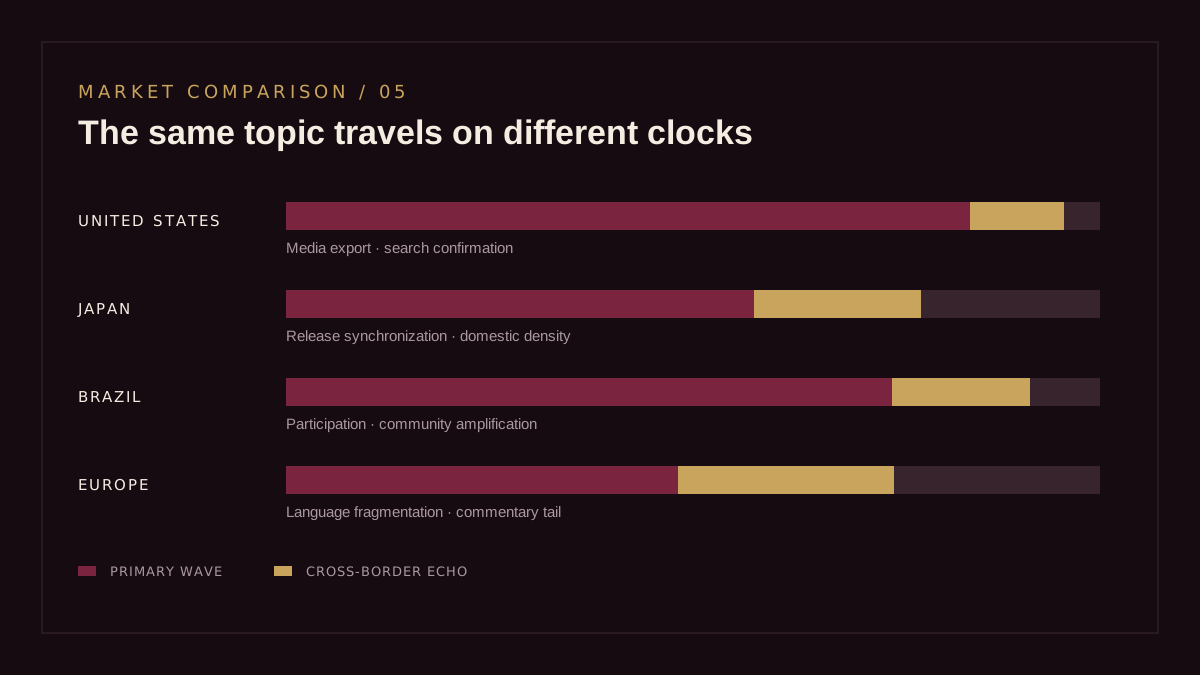
Market comparisons prevent a local board from masquerading as a global one. The United States exports media narratives, Japan synchronizes around domestic broadcast and release systems, Brazil amplifies through highly participatory communities, and Europe splits attention across languages. A topic becomes genuinely global only when independent regional curves begin to overlap.
Entries are selected when they reveal one of these mechanics clearly. The goal is not to preserve every hashtag but to explain the few conversations whose movement teaches something reusable about platform incentives, audience behavior and cross-border discovery.
Source quality is part of the classification. A platform trend panel shows that a phrase is accelerating, but it does not explain whether the cause is breaking news, coordinated fandom, paid promotion or a naming collision. Editors compare the ranked term with search behavior, primary reporting and the originating artifact before assigning a topic to the ledger.
Propagation provides the second layer. Some topics remain discussion objects: people post opinions but do not create new artifacts. Others become participatory formats, generating clips, images and localized versions that can cross networks without the original wording. That distinction helps explain why two topics with similar peak volume can leave completely different cultural residue.
The archive is organized for comparison rather than chronology alone. Open a file to see its trigger, category, market mix and attention curve; then compare it with the People index when a public figure anchors the conversation or the Viral ledger when one shareable object drives the spread. Those links turn an isolated trend into a documented attention pattern.
No list can represent the entire public conversation. The observable layer favors open platforms, highly connected audiences and languages that tools can classify reliably. WhoTalking treats that bias as part of every reading: absence from a worldwide panel is not proof that a topic lacks importance, and a large visible wave is not proof that every market shares the same priorities.
A category-by-category ledger of the conversations that dominate global feeds and the forces that push each one to the top.